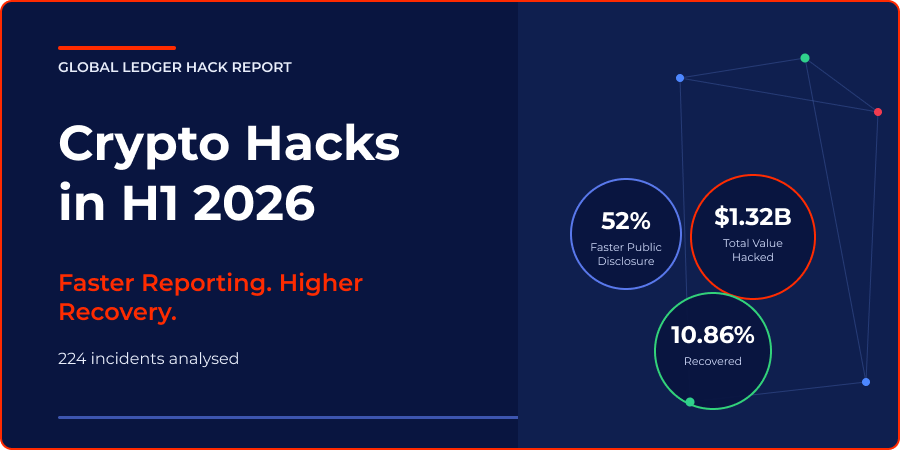


Inside the $387.5M Bitget hack: how stolen funds moved across chains, where they went, and what compliance teams and law enforcement need to know.
Held in Berlin from 6 to 7 May 2026, this year's European Police Congress — one of Europe's leading forums for law enforcement leaders, policymakers, and security experts — confirmed that financial crime, digital assets, artificial intelligence, and cross-border intelligence cooperation are rapidly converging into a single operational agenda for European authorities.
Representing Global Ledger at the conference, Yulia Murat, Head of Regulatory Affairs, attended the congress and shared the themes and insights that matter most for law enforcement today.
.jpeg) Yulia Murat, Head of Regulatory Affairs, representing Global Ledger at the European Police Congress 2026
Yulia Murat, Head of Regulatory Affairs, representing Global Ledger at the European Police Congress 2026
.jpeg.jpeg) Yulia Murat, Head of Regulatory Affairs, representing Global Ledger at the European Police Congress 2026
Yulia Murat, Head of Regulatory Affairs, representing Global Ledger at the European Police Congress 2026
.jpeg.jpeg) Yulia Murat, Head of Regulatory Affairs, representing Global Ledger at the European Police Congress 2026
Yulia Murat, Head of Regulatory Affairs, representing Global Ledger at the European Police Congress 2026
Straight from the European Police Congress: Key Insights for Law Enforcement
Across two days of panels, keynotes, and operational discussions, several themes emerged with striking consistency. Here is what stood out.
1. Money laundering remains one of Europe’s largest under-addressed security threats
Key figures discussed during the AMLA session illustrate the scale of the challenge:
Source: AMLA session, European Police Congress 2026
These numbers highlight a persistent structural gap between the scale of illicit financial activity and the ability of authorities to identify, trace, freeze, and recover criminal assets.
What this means for law enforcement:
-
Faster tracing of illicit value flows is becoming operationally critical.
-
Entity-based transaction intelligence is needed to connect the dots across cases.
-
Cross-border exposure analysis can no longer be treated as optional.
-
Tools capable of identifying hidden financial relationships across jurisdictions are increasingly in demand.
2. FIUs remain the operational gateway between reporting entities and law enforcement
FIUs continue to receive suspicious activity reports from obliged entities, analyse and enrich financial intelligence, and disseminate actionable intelligence to law enforcement, prosecutors, and supervisory authorities.
However, the volume, complexity, and speed of financial flows are increasing faster than traditional analytical structures.
What this means for law enforcement:
-
Automated transaction enrichment is becoming a necessity.
-
Entity attribution at scale requires purpose-built analytical tooling.
-
Visual analytics and prioritisation of investigative leads can meaningfully reduce analyst workload.
-
Scalable intelligence workflows — particularly for digital asset investigations — are becoming an increasingly high priority on the agenda.
3. Crypto-assets are now a mainstream law-enforcement challenge
One of the clearest shifts observed across multiple sessions was the normalisation of crypto within operational law-enforcement discussions.
Authorities increasingly recognise that digital assets enable rapid international movement of value, movement across multiple asset classes and technological layers, and concealment through decentralised infrastructure and fragmented transaction chains.
This creates growing investigative pressure across organised crime, cybercrime, sanctions evasion, fraud, and international asset recovery.
What this means for law enforcement:
-
Blockchain investigations and cross-chain tracing are now core investigative capabilities that agencies need to build and continuously strengthen.
-
Entity intelligence and attribution methodologies are in active operational demand.
-
Public-sector operational support for digital asset investigations is growing in urgency and institutional priority.
The congress confirms that blockchain analytics is increasingly viewed as core investigative infrastructure rather than a specialist capability.
4. AMLA represents a structural shift in European financial intelligence
A recurring message was that AMLA introduces a new institutional model for Europe by bringing together supervisory coordination, financial intelligence cooperation, and cross-border analytical capability under one institutional framework — a significant departure from Europe's historically fragmented AML landscape.
The real value of AMLA appears to lie not only in supervision, but in generating actionable cross-border financial intelligence.
What this means for law enforcement:
-
Cross-border transaction mapping should become more systematic and better coordinated.
-
Multi-jurisdictional exposure analysis should be integrated into supervisory workflows.
-
Digital-asset supervisory intelligence is expected to be a priority area.
-
Typology-driven investigative workflows are gaining institutional traction — demand for structured, pattern-based investigation approaches is expected to grow alongside AMLA's operational build-out.
5. AI is moving from experimentation into operational investigations
The dominant trend is clear: authorities are moving from pilot projects towards operational deployment of AI-driven investigative tools.
At the same time, there is a growing focus on explainability, auditability, legal defensibility, data sovereignty, and operational transparency. Authorities increasingly want analytical systems that can produce operational outcomes while remaining defensible in court, supervision, and public scrutiny.
What this means for law enforcement:
-
Explainable analytics and transparent risk methodologies are becoming selection criteria — not just nice-to-haves.
-
Audit-ready analytical outputs are required for court admissibility.
-
AI-assisted prioritisation of investigative leads creates real opportunities to reduce case backlog and focus investigative resources where they matter most.
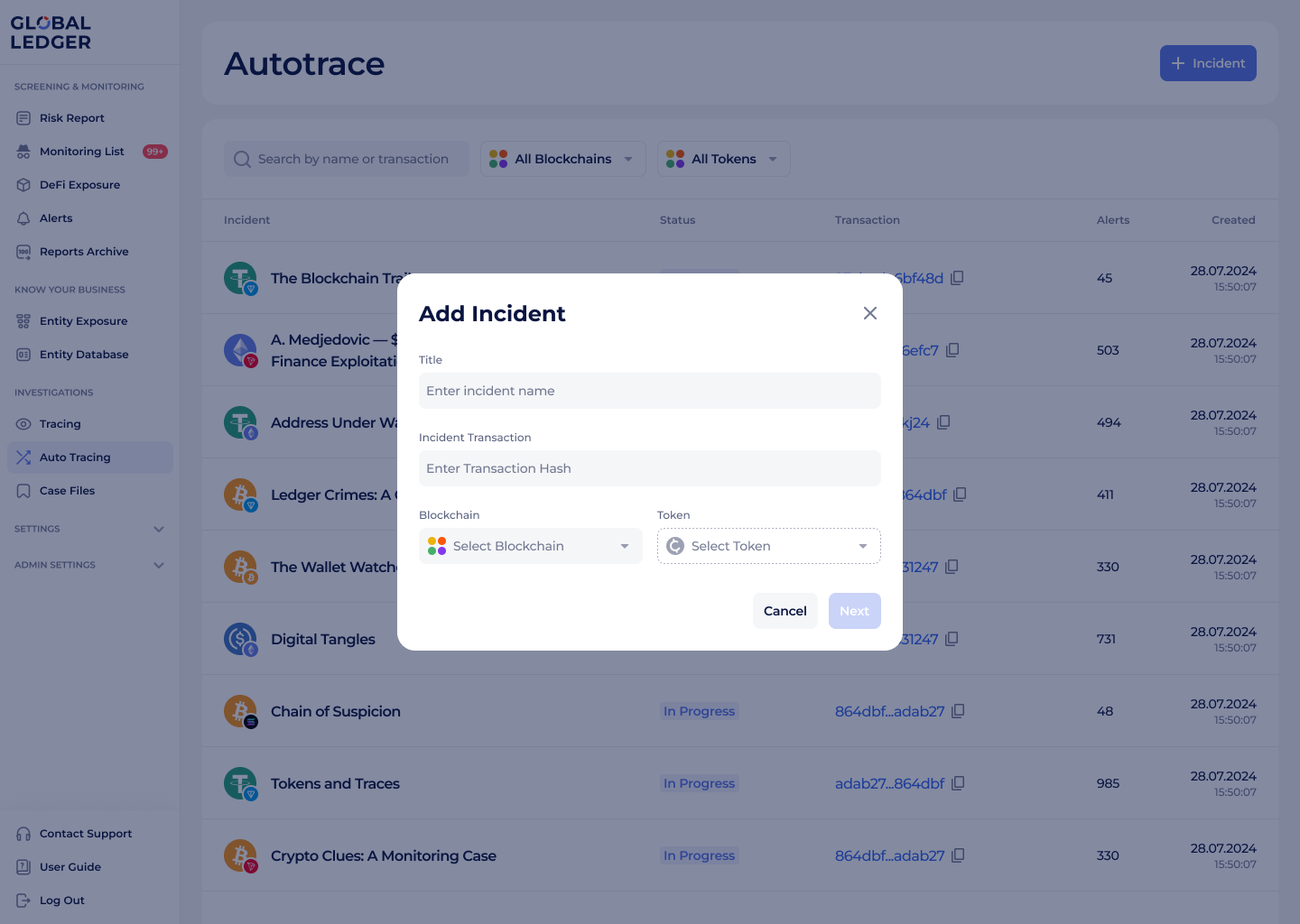
A partial view of the AutoTrace Case Management interface in the Global Ledger platform. Source: Global Ledger
6. Public-sector procurement is becoming more technology-driven and operationally focused
As a result, authorities increasingly need specialised investigative technology while retaining operational autonomy, legal compliance, and control over sensitive intelligence.
What this means for law enforcement:
-
Procurement processes are becoming more agile, making it easier for agencies to adopt new investigative tools.
-
The barrier to accessing specialised investigative technology is gradually coming down.
-
Agencies have more options than ever when it comes to integrating specialised tools into existing workflows.
7. Capacity building is becoming a strategic priority for law-enforcement agencies
Authorities increasingly emphasise investigator training, cross-border knowledge exchange, operational education, international learning formats, and practical investigative exercises.
The strategic shift is clear: from acquiring tools towards building operational investigative capability.
What this means for law enforcement:
- Investing in FIU training and investigator education is becoming as strategically important as investing in technology — agencies that build internal expertise will get significantly more value from the tools they deploy.
- Cross-border simulations and joint exercises are increasingly valued as a way to build shared investigative capability and prepare teams for complex, multi-jurisdictional cases.
Conclusion
The European Police Congress confirmed that Europe's law enforcement and financial intelligence units are entering a period of accelerated operational modernisation.
The convergence of financial crime, digital assets, AI, and cross-border cooperation is no longer a future agenda — it is the present one, where Technology + Intelligence + Training are working in close alignment.
As money laundering scales and illicit value moves faster across chains and jurisdictions, law enforcement agencies need more than access to data — they need tools that turn blockchain transactions into actionable intelligence, hold up in court, and support cross-border cooperation. That is exactly what Global Ledger is built to do.
With Global Ledger's crypto investigations tool, your team can:
-
Trace complex digital financial flows across chains and jurisdictions.
-
Analyse illegal activity across darknet, mixers, swaps, smart contracts, and multi-hop transactions.
-
Collect court-ready evidence with shareable visuals and clear transaction flow breakdowns.