
Bank of America $1.2 billion fine: what FinCEN, OCC and OFAC found, what $5B in late SARs means, and how the lessons apply to crypto compliance.
The scale of crypto-related losses has shifted dramatically in just one year. In 2024, attackers stole $1.94 billion across 265 incidents. By the end of 2025, that figure more than doubled — reaching $4.04 billion across 255 incidents, according to Global Ledger research.
As the amount of stolen funds grows, new schemes are forming around these incidents. One of them is crypto recovery scams — services that claim to help recover lost assets but instead create additional risk.
This article explains what crypto recovery scams are, how they work, how to recognize warning signs, and how to identify legitimate crypto recovery companies without adding further risk.
What Is a Crypto Recovery Scam?
Crypto recovery scams — also called fund recovery scams or impersonation scams — are schemes where criminals pretend to be someone who can help you get your money back. They might pose as lawyers, blockchain analytics firms, or even government representatives. They charge an upfront fee, promise results, and then disappear.
The key mechanism that makes this scam effective is brand impersonation. Scammers don't present themselves as unknowns. They copy the logos, domains, and documentation of real blockchain analytics companies to appear credible.
The Scale of the Problem
According to the Global Ledger research, nearly $2 billion of stolen funds remained unspent, meaning they had not yet been moved or cashed out. This creates a large pool of assets that users and companies still hope to recover.
But the actual recovery rates remain low. Only around 7% (or $263.23 million) of stolen funds were returned across those cases. This gap between expected and realistic recovery outcomes is where recovery scams operate.
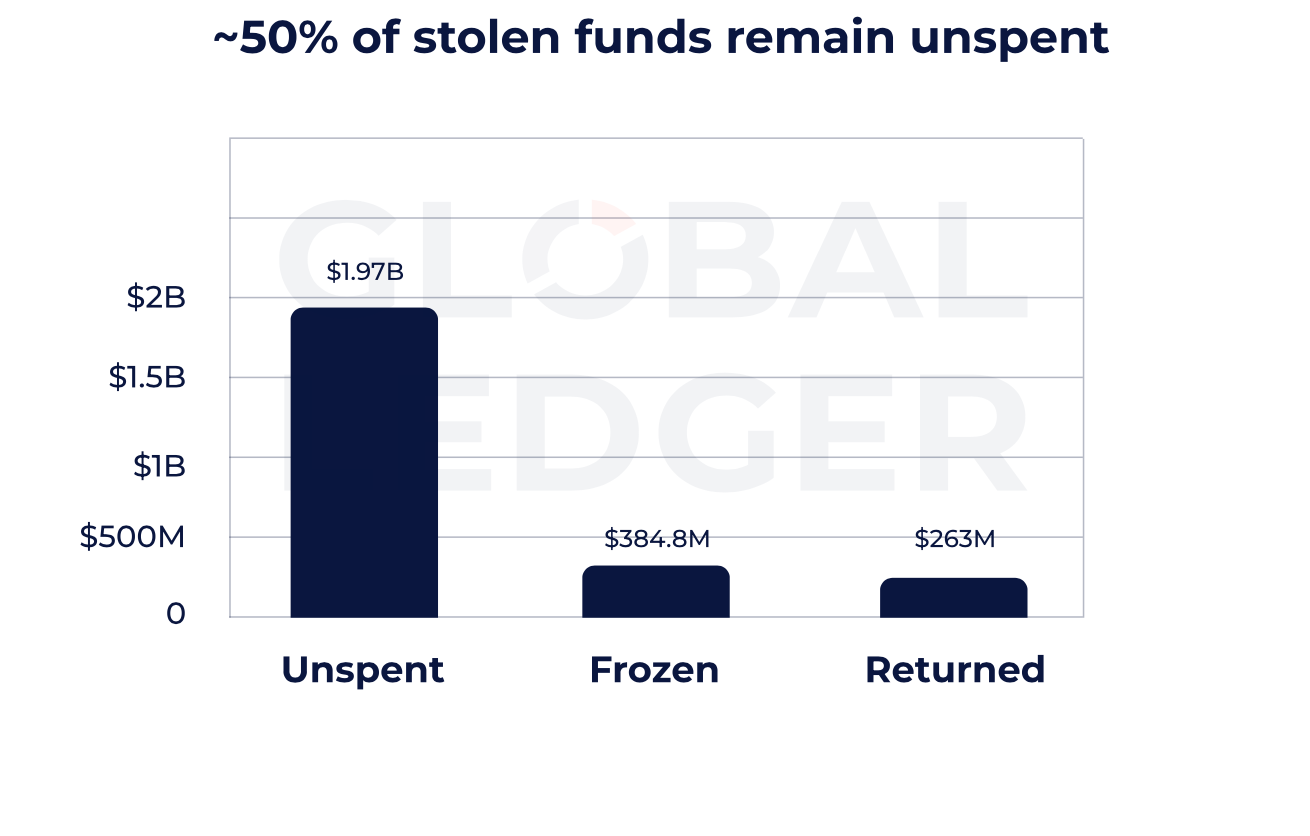
The amount of stolen crypto funds that remained unspent. Source: Global Ledger
This scale is already prompting government action. The FBI's Internet Crime Complaint Center (IC3) received 181,565 cryptocurrency fraud complaints totaling more than $11 billion in losses in 2025 — a 22% increase from 2024. The FBI has now issued three successive public service announcements specifically warning about fake crypto recovery services: in August 2023, updated in June 2024, and updated again in August 2025. The repeated updates reflect a problem that is growing, not stabilizing.
The North American Securities Administrators Association (NASAA) — the primary regulator for state-level securities enforcement in the US — has also published a dedicated advisory on "Crypto Recovery Room Scams", identifying the pattern as a distinct and documented threat to retail investors.
Why It’s Really the Problem
Fund recovery scams cause two distinct types of harm — one to individual users, one to the companies whose names are being copied. Both matter, and both are worth understanding.
1) Individuals are targeted at their most vulnerable moment
They are stressed, searching for help, and more likely to trust anyone who sounds official. Scammers use that window deliberately — arriving with professional-looking websites and names borrowed from real companies. The result is a second financial loss on top of the first.
2) Legitimate companies lose trust they didn't damage
A person who encounters a fake site (unless it looks like “official”) and gets defrauded is unlikely to distinguish the impersonator from the real firm afterward. The reputational damage is real, even though the legitimate company did nothing wrong. This forces real firms to spend resources monitoring and removing fraudulent domains they never created.
3) The scam targets exactly the people trying to fix the problem
Blockchain analytics companies are credible, technical, and exactly what a user would search for after financial losses. That's precisely why scammers copy them. It creates a trap where seeking expert help can lead directly into another fraud — unless the user knows how to verify who they're actually talking to.
How Crypto Recovery Scams Work: Step-by-Step
Fund recovery scams follow a consistent operational pattern. Understanding each stage helps identify the scheme before money “changes hands”.
Step 1. Finding victims
Scammers do not wait for victims to find them. They actively source contact lists of people who have already reported crypto losses — through forums, social media posts, complaint boards, and data obtained from darknet marketplaces.
Someone who has posted publicly about losing money to a fake exchange or pig butchering scheme is a “qualified lead” for a recovery scammer.
Step 2. Impersonating a credible brand
Case 1. Website
Once scammers make contact, they present a fabricated identity: a law firm specializing in crypto-related cases, a blockchain analytics company, or a government-affiliated recovery unit. They support this identity with copied logos and fake domain names that closely resemble real companies. An example of a fraudulent website impersonating Global Ledger is shown below.
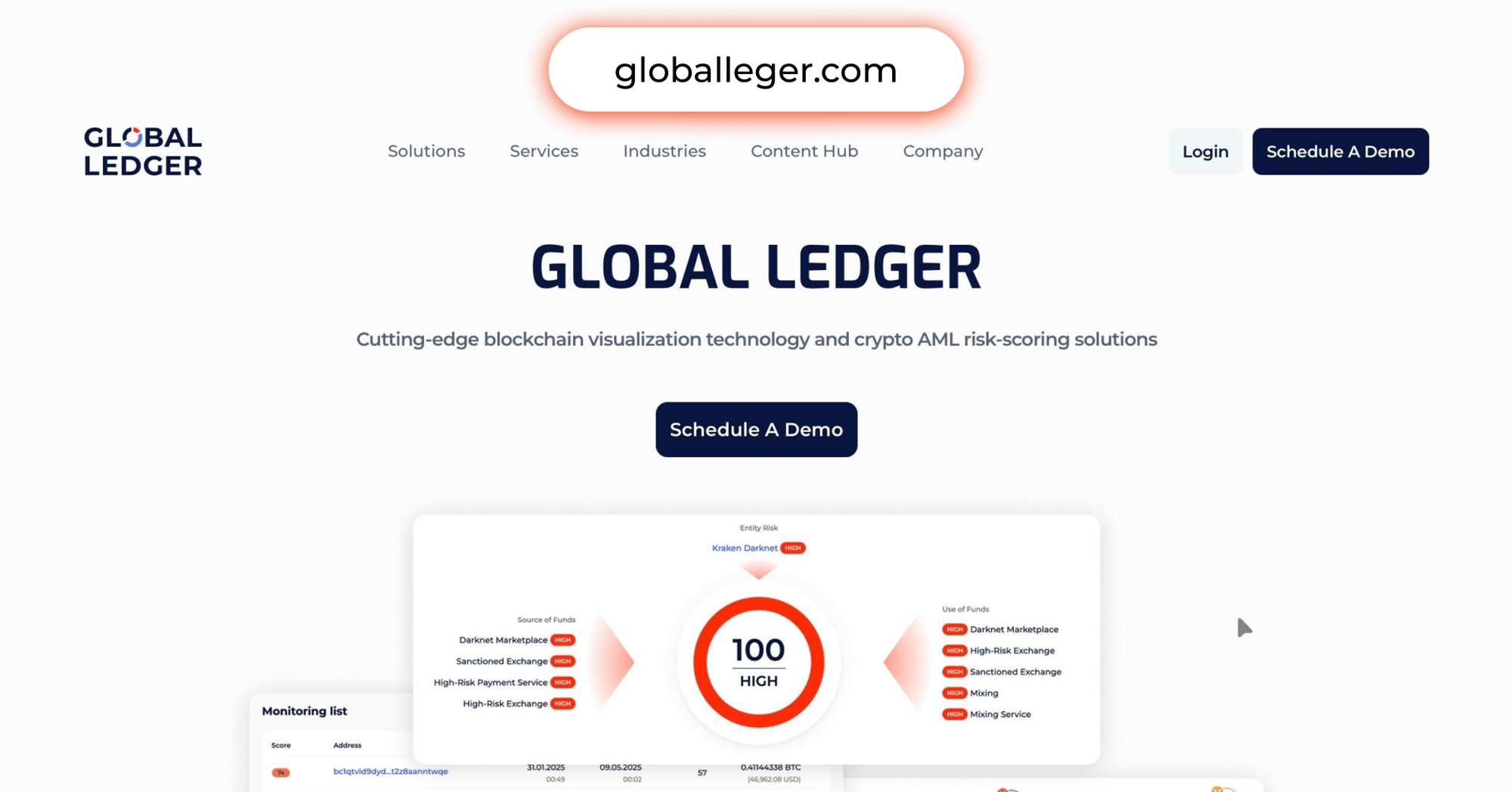
Example of a fraudulent website impersonating Global Ledger
This brand impersonation specifically targets well-known names in the blockchain analytics space. These are the exact companies a fraud victim would search for, which makes their names the most valuable ones to copy.
Case 2. Emails
Brand impersonation doesn’t always mean a fake website. In April 2026, a user contacted Global Ledger after receiving an email that appeared to come from contact@globalledger.io — complete with the company’s logo and branding. The email instructed the recipient to set up a crypto wallet and add a custom token contract. It was a spoofed address: the email was never sent by Global Ledger.
Important: If you receive an unexpected email from any blockchain analytics company asking you to take action with your wallet, do not follow the instructions. Contact the company directly through their official website to verify.
Step 3. Establishing false authority
The scammer claims to have access to government records or case files showing that the user’s funds are recoverable. Some also claim the person was included on a government-affiliated list and that funds can be recovered through "legal channels."
Step 4. Collecting the upfront fee
The scammer requests payment — typically in cryptocurrency or prepaid gift cards — to initiate the recovery process. They may ask users to pay a portion of the fee upfront, with the balance due after recovery. They may also request payments for “taxes” or other fabricated charges. The promised recovery never occurs.
Step 5. Escalation or disappearance
Some operations disappear immediately after the first payment. Others continue, inventing new fees — administrative charges, tax clearances, international transfer requirements — to extract additional money from people before eventually cutting contact.
Are Crypto Recovery Services Scams? Red Flags to Check
Not every company offering crypto recovery assistance is fraudulent. But the following indicators can be associated with scam operations, not legitimate firms.
Legitimate Crypto Recovery Companies: What They Actually Do
Legitimate blockchain analytics and asset recovery firms operate transparently and verifiably. Here is what distinguishes a real crypto asset recovery company from a fraudulent one.
- Legitimate companies always conduct a preliminary assessment
A real firm starts with a brief consultation or scoping call to evaluate whether recovery is technically feasible — before asking for significant payment. This involves reviewing available transaction data to determine where funds moved and whether any recovery path exists.
- Legitimate companies use proprietary blockchain analytics tools
Real companies use professional tools to trace fund flows across chains, through mixers, and into exchanges. This work results in clear, evidence-based reports that can be used by law enforcement or in legal proceedings. You can usually verify this by checking what tools and methods a company describes on its website.
- Legitimate firms are transparent about limitations and timelines
Crypto asset recovery is not guaranteed. It depends on how quickly the engagement starts after the incident and whether exchanges or law enforcement can cooperate to freeze or return assets.
Conclusion
Crypto recovery scams work because they look exactly like the help you need. The domain looks right, the branding looks familiar, the promises sound reasonable. The only reliable way to tell the difference is to verify independently and never pay before you have something in writing.
If you've lost funds to crypto fraud, the most important step is to start the tracing process as early as possible — the longer stolen assets stay on-chain without intervention, the harder recovery becomes.
We're here to help you start your crypto recovery. Our investigation team provides an immediate assessment, offers expert consultation, maintains transparent
communication, and connects you with reliable partners for further legal recovery when needed.
FAQ