
Inside the $387.5M Bitget hack: how stolen funds moved across chains, where they went, and what compliance teams and law enforcement need to know.
Laundering is fast and cheap, while compliance remains slow and expensive. This is the core summary of where the industry stands in 2026, and it was at the center of almost every conversation Global Ledger had at Consensus 2026 in Miami.
On the sidelines of Consensus Miami 2026 by CoinDesk, a number of focused panels and side events took place, covering specific topics in more depth. One of those was the "Digital Asset Security & Compliance in 2026" panel at the Rooftop Web3 Cinema Club, hosted by Hacken, Blockchain Security & Compliance and 1inch, alongside Ethereal Labs.
At this panel, Goran Safar, Head of Sales at Global Ledger, joined experts working across compliance, on-chain intelligence, and blockchain security to discuss where the industry is falling short and what needs to change.
Before getting into the panel discussion, here is a quick look at the main themes that defined Consensus this year.
.jpeg) Panel discussion “Digital Asset Security & Compliance” during Consensus 2026
Panel discussion “Digital Asset Security & Compliance” during Consensus 2026
.jpeg) Panel discussion “Digital Asset Security & Compliance” during Consensus 2026
Panel discussion “Digital Asset Security & Compliance” during Consensus 2026
.jpeg) Panel discussion “Digital Asset Security & Compliance” during Consensus 2026
Panel discussion “Digital Asset Security & Compliance” during Consensus 2026
Consensus Miami 2026: The Biggest Annual Gathering for Digital Assets and Finance
Consensus 2026 is one of the largest Web3 and digital finance events in the world, bringing together 20,000+ senior leaders from crypto, finance, tech, and policy. Held from May 5–7 in Miami Beach, it gathered founders, exchange CEOs, regulators, and policymakers to set the agenda for the industry's next phase.
What was on the agenda:
-
AI agents in crypto — speakers described AI agents as the next major user base in digital finance, able to execute transactions and manage wallets autonomously. For compliance teams, this also means AI alerts prioritization and real-time monitoring are quickly becoming a must-have in day-to-day operations.
-
Stablecoins and RWA tokenization — dominated both product and policy conversations, with MiCA's July 2026 enforcement deadline in the EU and the GENIUS Act moving toward finalization in the US putting additional pressure on licensed platforms.
-
Crypto legislation — CFTC Chairman, senators, and congressional representatives discussed digital asset market structure and tax reform. The shared takeaway: clear regulation moves adoption forward faster than new technology does.
-
Institutional capital entering the market — Morgan Stanley and JPMorgan joined as sponsors, reflecting a broader shift in how seriously traditional finance is now treating digital assets. The more institutional money flows into digital assets, the harder it becomes to ignore gaps in compliance infrastructure.
The faster the Web3 industry grows, the more attractive it becomes for bad actors. That was the focus of the panel "Digital Asset Security & Compliance in 2026," held on May 5 as part of the main Consensus 2026 event.
Digital Asset Security & Compliance in 2026: What the Panel Was Really About
The discussion opened with a question the industry keeps circling around: if the tools, the frameworks, and the intent are all there — why is illicit money still getting through?
The answer the panel kept returning to was straightforward. It is not a gap in regulation or awareness. It is a timing problem: risk moves faster than most compliance systems are built to respond. That gap — between how fast laundering happens and how fast compliance can react — was the thread running through every part of the conversation.
The attack vectors most compliance teams still underestimate
Most teams underestimate the speed at which laundering happens after an incident.
According to Global Ledger research, hackers start moving stolen funds within 17 hours of an attack. The affected entity, on average, takes 34 hours to report it publicly. That 17-hour window is more than enough to fragment funds across unhosted wallets and route them through cross-chain infrastructure. By the time an alert is raised, the trail has already split into multiple directions.
A swap on a DEX takes about 10 minutes and a transaction fee to turn A7A5 into clean USDT on a centralized exchange. It can happen while a compliance officer has just stepped away to make coffee. If the response window is longer than 10 minutes, the exposure has already arrived.
The $13B reality: exposure that lives a few hops away
Licensed exchanges collectively processed close to $13 billion in indirect exposure to illicit funds over the past two years — not because controls were absent, but because this type of risk rarely announces itself at the front door.
Most of the exposure that reaches licensed exchanges does not arrive directly. It moves through intermediaries, accumulates across hops, and lands on a regulated platform looking clean on the surface.
AI in compliance: what it actually changes
One of the more grounded parts of the discussion was around AI — not as a future concept, but as something already changing how compliance operates day-to-day.
AI does not replace compliance judgment. It removes manual workload from the tasks that do not require it: alert triage, pattern recognition, and prioritization at volume. That is where teams lose time, and that is where automation makes the biggest practical difference.
Without automation, you are fighting a high-speed laundering machine with a manual process. The machine wins on volume every time.
What compliance infrastructure actually needs to look like
The panel did not close on a general call for better tools. It closed on concrete benchmarks, because the gap between current performance and what is actually needed is measurable.
An ideal setup that stops ~98% of cases:
-
Reporting within 10 minutes
-
Labeling in ~10 minutes
-
Alerting and blocking in under 1 second
A more realistic target (50% of cases) that could stop roughly half of all incidents:
-
Victim reporting within 24 hours
-
Labeling and clustering in under 4 hours
-
Alerting and blocking within 30 seconds
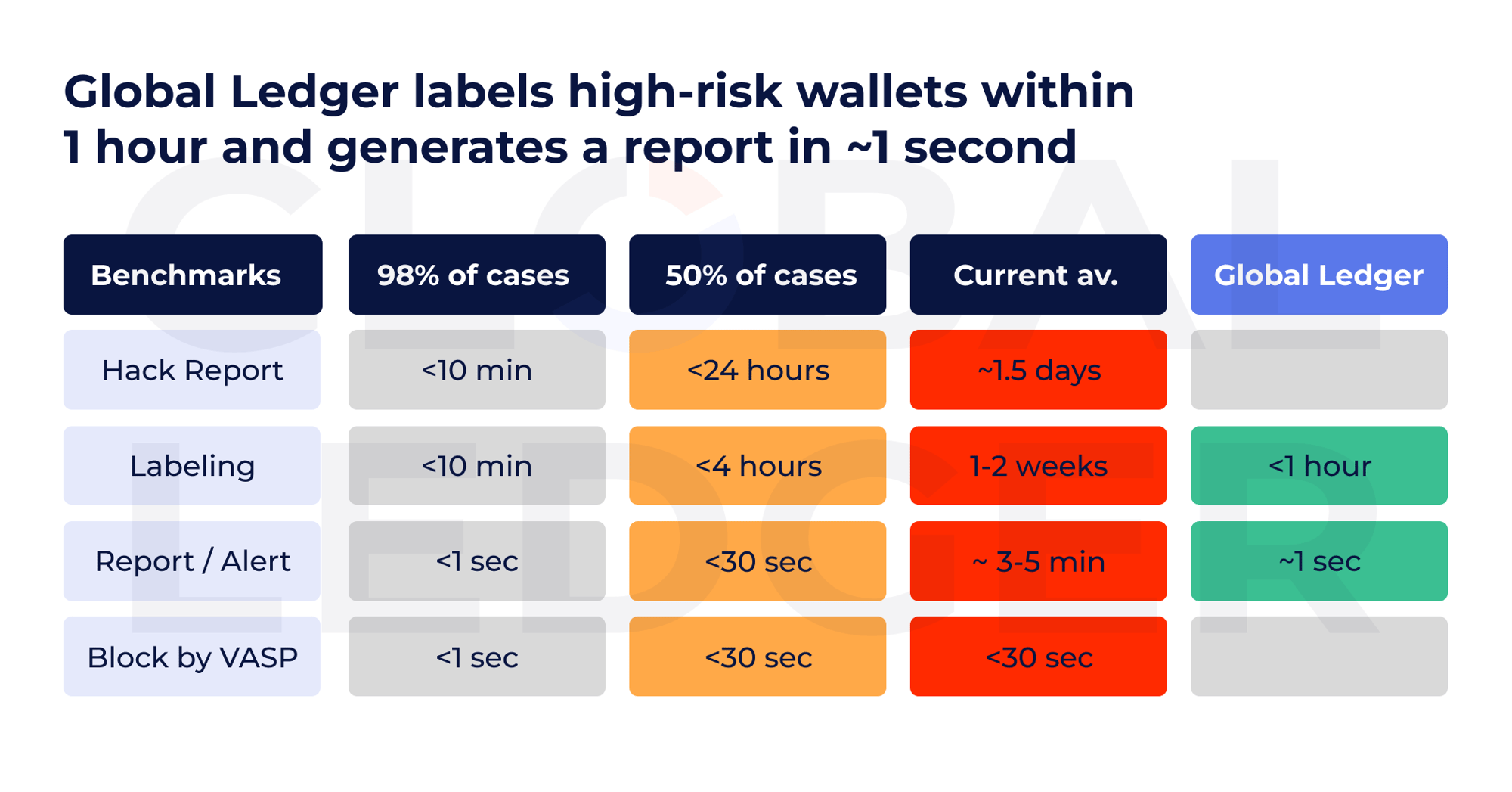
Timeframes for how Global Ledger labels high-risk wallets and generates reports. Source: Global Ledger
Why these numbers matter: when funds from a high-risk address reach a licensed platform, the response window is narrow — typically 10–15 minutes. If no action is taken in that window, assets are likely to move again — into a mixer, another exchange, or off-ramped entirely. From this point on, exposure is entering the regulated cryptocurrency market.
Two Things the Panel Made Clear for Every Compliance TeamThe Consensus panel reinforced something our data has been pointing to for months:
1. The risk can be closer than you think
The most common exposure categories include:
-
Iranian sanctioned flows — often sitting 2–5 hops away via USDT on TRON or BNB Chain.
-
Stolen funds — laundered through DEXs and cross-chain bridges within hours of an incident.
-
Terrorist financing — low volume, highest regulatory consequence.
-
Darknet-linked transactions — funds that have passed through darknet markets somewhere in the chain.
-
Mixer activity — routing through Tornado Cash (now the #1 mixer since sanctions were lifted in March 2025) and similar services.
-
Russia’s hidden economy — Grinex, A7A5, and Garantex-linked wallets that continue to operate.
2. MiCA is live, and indirect exposure counts
In our audits, 7 out of 10 exchanges had some form of sanctioned exposure — and in most cases, it came through indirect counterparties, not direct transactions. Under MiCA, that distinction does not reduce liability.
Even multi-hop exposure to sanctioned entities is enough to trigger regulatory scrutiny, put banking relationships at risk, or result in a license review.
The reason most of those exchanges had exposure in the first place comes down to three things the panel kept returning to:
-
Speed: Compliance is slow and expensive. Laundering is fast and cheap. That equation has not changed.
-
Depth: Most AML tools check direct counterparties. Indirect exposure — the kind that makes up the bulk of sanctioned flow — sits further down the chain where standard checks do not reach.
-
Automation: Without it, compliance teams are manually processing alerts while risk moves at machine speed.
Conclusion
The Consensus 2026 side-event panel brought one thing into focus: the compliance conversation in digital assets has moved on from whether the risk exists. The more pressing question now is whether your infrastructure is fast enough to catch it before it settles.
Laundering is already fast and cheap. Compliance, in most cases, is not. The gap between those two realities is where billions keep disappearing — quietly, across a few hops, before anyone raises an alert.
There is a 90% chance that a licensed exchange already has some form of exposure. The only question is what kind of exposure. Sometimes it is worth double-checking — not only to understand where exposure sits in the chain, but to get ahead of it before it becomes a regulatory conversation instead of a compliance one.