

Explore key findings from 224 publicly disclosed crypto hacks in H1 2026, crypto crime trends, money laundering tactics and asset recovery strategies
For crypto businesses that operate in the European Union or plan to do so, the Markets in Crypto Assets Regulation (MiCA) matters a lot. It's an EU–wide regulatory framework governing crypto asset services, including the provision of crypto licenses in Europe.
The logic of MiCA is relatively straightforward:
Although in practice, classification and scope analysis can be complex and fact-specific.
But getting the meaning of MiCA wrong at the outset can lead to the wrong licence, the wrong product structure, and serious regulatory risk.
Here we’ll examine what falls within MiCA’s scope, what remains outside it, how the framework classifies tokens, and what can happen when a business gets the MiCA analysis wrong or ignores it altogether.
What the MiCA Regulation Is and Where It Stands Now
Before MiCA, crypto businesses faced inconsistent treatment from one member state to another. That fragmentation created legal uncertainty, uneven standards, and opportunities for regulatory arbitrage.
MiCA was introduced as a solution to establish a harmonised EU-wide framework for issuers and crypto asset service providers (CASPs).
The MiCA Regulation Timeline in the EU, Based on the Official Source:
- 20 April 2023: the European Parliament gave political approval to MiCA.
- 31 May 2023: the regulation was formally signed.
- 29 June 2023: MiCA entered into force.
- 30 June 2024: the rules for ARTs and EMTs started to apply.
- 30 December 2024: the rest of the MiCA regime started to apply, including for CASPs.
- 1 July 2026: the maximum transitional period ends for certain CASPs in member states that chose to allow it. The availability of transitional periods depends on the implementation choices of individual Member States.
How Does MiCA Work
MiCA regulates in-scope crypto-asset issuers, offerors, persons seeking admission to trading, and CASPs; imposes disclosure and conduct standards; and introduces a single system that applies across EU member states (official source):
- Authorisation and supervision of service providers
Crypto-Asset Service Providers (CASPs), including exchanges, custodians, advisory firms, and others, must be authorised by competent authorities and comply with compliance and operational standards. These include capital requirements, governance rules, and obligations to handle client assets securely.
- Crypto-asset whitepaper requirements
Before offering crypto assets to the public, offerors or persons seeking admission to trading under MiCA must publish a detailed crypto-asset whitepaper. This whitepaper must be prepared and notified to the relevant competent authority, without prior approval in most cases. The rules are stricter for asset-referenced tokens (ARTs) and electronic money tokens (EMTs).
- Specific rules for stablecoins
MiCA imposes strict stablecoin regulation, dividing them into Asset-Referenced Tokens (ARTs) and Electronic Money Tokens (EMTs). Issuers of EMTs must be authorised as credit institutions or electronic money institutions, while ART issuers are subject to a distinct authorisation regime and additional prudential and governance requirements.
- Market abuse prevention
MiCA introduces a market abuse framework tailored to crypto-assets, drawing on principles from traditional financial regulation. It extends certain concepts from traditional financial regulation to the crypto space and requires trading platforms to prevent and report unfair practices.
- Single passport for cross-border operations
Firms authorised under MiCA in one EU member state can provide their services within the scope of their authorisation across all member states – a mechanism known as “passporting.”
So, in brief, MiCA is designed to regulate the crypto asset offering in the EU and to structure the way crypto assets are issued, marketed, and serviced.
One of the main stumbling blocks, however, is determining whether a given product qualifies as a crypto asset under MiCA. The view taken by businesses in practice often differs significantly from that of regulators.
Here’s what the regulation says.
Crypto Asset Categorisation According to MiCA
The MiCA classification system is not based on self-proclaimed brand categories such as “DeFi token”, “governance token”, or “game token”. Regulators will look at the token’s actual features, such as the rights it confers, any stabilization mechanisms, and its economic function. That’s what will determine its classification.
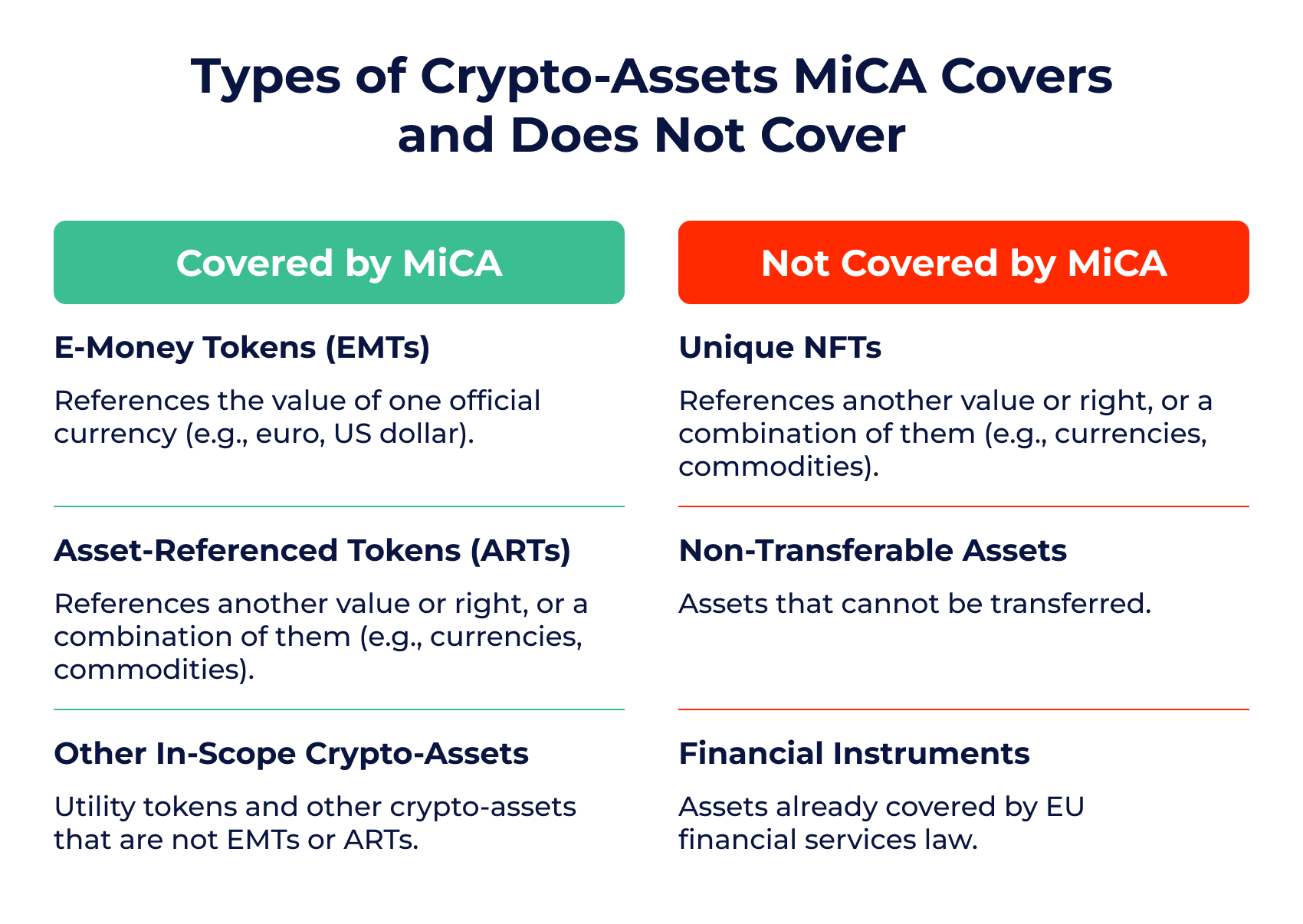
With that in mind, here are the official MiCA categories:
- E-money tokens (EMTs):
MiCA defines e-money tokens as crypto assets that maintain a stable value by referencing one official currency. - Asset-referenced tokens (ARTs):
Crypto-assets that maintain a stable value by referencing another value or right, or a combination of them. This can include one or more official currencies, commodities, or other assets. - Other crypto-assets:
This is a catch-all category for everything that falls under MiCA but isn’t an EMT or ART. This category includes utility tokens, which are specifically defined under MiCA as crypto-assets that are intended to provide digital access to a good or service and are only accepted as payment for that good or service by the issuer of the token.
There’s also what you might call an "NFT warning label":
If a crypto asset is genuinely unique and non-fungible, it may fall outside the scope of MiCA. However, if an NFT is fractionalised or issued as part of a series or collection, it may still be considered a crypto-asset under MiCA depending on its characteristics and degree of fungibility (substance-over-form assessment).
To understand whether a project is “in” or “out” of regulation, you can check this infographic:
MiCA Regulation Costs
Despite its regulatory benefits, MiCA is not universally seen as good for the industry. One of the main criticisms is how much a MiCA license costs — and authorisation costs vary significantly across the EU because national fee regimes are not harmonised.
For example:
For CASPs, this means that even under a single MiCA framework, fees and supervisory practices can still differ from one jurisdiction to another.
What if You Are Required to Have a MiCA Licence but Do Not Obtain It or Ignore the Requirement Altogether?
If your business falls under MiCA, not getting the required licence or failing to meet the regulation’s requirements can have serious consequences. Here is what that can mean in practice.
If MiCA Applies and You Are Not Authorised or Compliant
Operating in the EU without the required MiCA authorisation is not simply a commercial risk — it is a regulatory breach with potentially serious consequences.
In practice, this means:
- You may be required to cease the activity immediately (including suspension of services or platform access in the EU).
- Competent authorities may impose administrative sanctions, including significant fines, public warnings, and remedial orders.
- You may be subject to enforcement action, including orders to unwind activities, return client assets, or restrict business operations.
- Your ability to onboard or retain EU clients may be directly impacted, including forced offboarding.
- You may be excluded from operating cross-border within the EU until properly authorised.
- In some cases, breaches may expose the business and its management to additional legal or supervisory consequences under national law.
- Beyond regulatory action, the practical impact is immediate: banks, payment providers, and regulated counterparties are unlikely to engage with an unauthorised entity, and existing relationships may be terminated.
In short, if MiCA applies, authorisation is not optional. It is a prerequisite to operating lawfully in the EU market.
If you misread or neglect MiCA obligations
If a crypto project misinterprets its obligations under MiCA or fails to meet certain requirements, it faces multiple risks:
- supervisory intervention
- enforcement action
- regulatory measures
- fines or other penalties
- required changes to the product, governance, or disclosures
- client complaints and remediation costs
Under MiCA, national authorities have a range of tools to enforce compliance, including the power to withdraw authorisation, impose penalties, and require corrective action. Failing to meet MiCA requirements can therefore have serious operational and reputational consequences.
MiCA’s Application for Key Industries
MiCA does not affect all crypto businesses in the same way. For some, it creates a direct licensing and operating framework. For others, it changes who they can work with, how they onboard clients, what counterparties they can trust, and how much regulatory risk sits behind everyday transactions.
Here’s how MiCA applies to major types of crypto market participants.
MiCA for CASPs
For exchanges, custodians, brokers, and other licensed crypto service providers, MiCA changes market access itself. If the business needs authorisation and does not have it, it cannot scale across the EU as a regulated operator.
And the problem is not only regulatory. It affects onboarding by banks, payment providers, fiat partners, larger clients, and other licensed firms that do not want exposure to an unlicensed or weakly controlled counterparty.
MiCa for OTC Desks and Brokers
For OTC desks and brokers, MiCA primarily affects how transactions are structured, documented, and justified. Activities such as large bilateral trades, cross-border flows, and bespoke client execution are typically in scope where they involve the execution or transmission of client orders, bringing these firms within the CASP regime.
Under MiCA, OTC desks must be able to clearly demonstrate how and why transactions are conducted. This includes robust client onboarding, documented decision-making, appropriate wallet screening, and a defensible understanding of source of funds and transaction rationale.
Practices that previously relied on relationship-based judgment or limited documentation become significantly more difficult to sustain. A desk that cannot clearly evidence its client acceptance decisions, transaction handling, and risk controls may face regulatory scrutiny and, in practice, may also find it more difficult to maintain relationships with banks, liquidity providers, and other regulated counterparties.
MiCa for iGaming and Gambling Platforms
For iGaming businesses, MiCA matters through dependency on the crypto stack around them. Even if the platform itself is not the primary MiCA-regulated entity, its deposits, payouts, treasury flows, and payment partners may depend on firms and assets that are.
That means misalignment can show up as unstable crypto payment rails, higher exposure to blocked or restricted funds, more friction around withdrawals, and more pressure to prove that player funds are not coming from sanctioned, stolen, or otherwise high-risk sources.
MiCa for Stablecoin Issuers and Crypto Payment Models
For stablecoin-based products, MiCA applies at the level of the token itself, not just the surrounding service. The classification of a token as an e-money token (EMT) or an asset-referenced token (ART) determines whether and how it can be issued, offered to the public, or admitted to trading in the EU.
EMTs must be issued by authorised credit institutions or electronic money institutions, while ART issuers are subject to a separate authorisation regime with additional prudential, governance, and reserve requirements. In both cases, issuers must meet strict obligations relating to white papers, disclosures, reserve backing, and ongoing supervision.
As a result, token design choices directly affect legal viability. If a token’s structure does not meet MiCA requirements, the business may need to revise the asset model, issuer entity, reserve arrangements, or disclosure framework before it can be lawfully marketed or used within an EU-facing offering.
For crypto payment models, the impact is typically indirect but significant. The ability to use a stablecoin within payment flows depends on whether the underlying token is compliant and issued by an authorised entity. Non-compliant tokens may be restricted from use by regulated intermediaries, affecting integration with exchanges, payment providers, and other financial infrastructure.
MiCa for Wallet Providers and Crypto Infrastructure Firms
For wallet providers and crypto infrastructure firms, MiCA’s impact depends on the nature of the service, in particular whether the provider exercises custody or control over client crypto-assets.
Custodial wallet providers fall within scope as crypto-asset service providers (CASPs) and must obtain authorisation. They are subject to requirements on safeguarding of client assets, governance, operational resilience, and conduct of business. This directly affects how custody is structured, how private keys are managed, and how client assets are protected.
Non-custodial wallets and certain infrastructure providers may fall outside the direct scope of MiCA. However, they are still affected indirectly through their integration with regulated entities. Exchanges, payment firms, and institutional clients increasingly require infrastructure that meets compliance expectations around traceability, sanctions exposure, and transaction monitoring.
As a result, even where MiCA does not apply directly, products that create uncertainty around custody, control, or risk visibility may face practical barriers to adoption. In this segment, MiCA alignment often emerges first as commercial pressure — slower integrations, increased due diligence, or lost enterprise relationships — before it becomes a formal regulatory issue.
EU MiCA regulation summary
The EU MiCA Regulation is the European Union’s legal framework for crypto-assets, crypto-asset issuers, stablecoin issuers, and crypto-asset service providers. It sets common EU-wide rules for authorisation, disclosure, conduct, consumer protection, and market abuse, with stricter requirements for stablecoins such as ARTs and EMTs.
MiCA is a regulation that is tailored for specific types of tokens and business models. If your project falls outside its scope, the obligations may be lighter. But knowing where you stand is critical: for CASPs, MiCA can provide a clear route to authorisation and access to the EU market. It requires a disciplined perimeter analysis, and in most cases, it’s what decides whether you can operate at all, how you design the offering, what laws apply, and what you need to be ready for.