

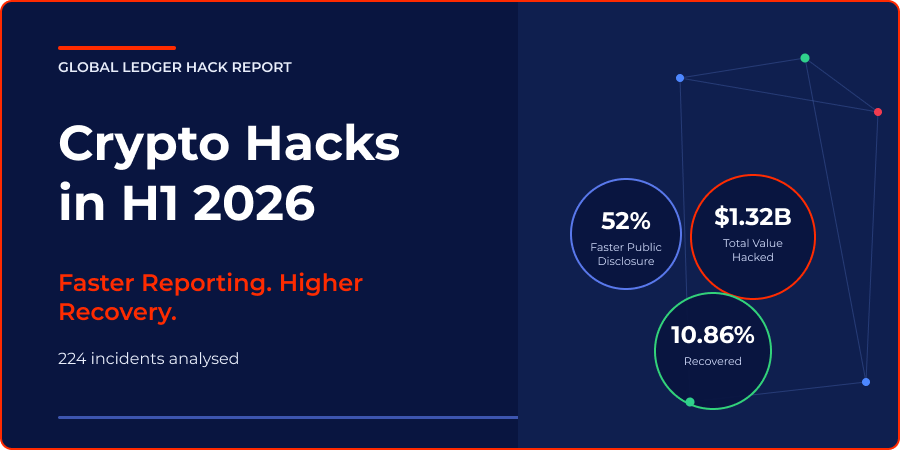
Explore key findings from 224 publicly disclosed crypto hacks in H1 2026, crypto crime trends, money laundering tactics and asset recovery strategies
EBA and ESMA publish a report on crypto in the EU
On 16th January the European Banking Authority (EBA) and the European Securities and Markets Authority (ESMA) published a Joint Report on recent developments in crypto-assets, analysing decentralised finance (DeFi) and crypto lending, borrowing and staking. The report was accompanied by two factsheets: on Decentralized Finance (DeFi) and on crypto lending, borrowing, and staking.
EBA and ESMA factsheet on DeFi
The fact sheet on DeFi provides an overview of the DeFi market in the European Union, analysing its size, risks, and potential implications for financial institutions and regulators.
The report highlights that DeFi remains a niche sector, accounting for only 4% of the total crypto-asset market capitalization, with an estimated 7.2 million DeFi users in the EU, though fewer than 15% engage regularly. The most common DeFi activities include staking, lending, borrowing, and crypto-asset exchanges, but euro-denominated stablecoins have limited adoption within DeFi applications. Despite its growing visibility, EU financial institutions have minimal exposure to DeFi, with banks largely refraining from crypto-related activities and investment funds holding only 0.02% of their portfolios in crypto-assets.
The report identifies several key risks associated with DeFi. ICT risks include vulnerabilities in smart contracts, price manipulation, governance attacks, and scams, alongside off-chain risks such as private key theft and phishing. Money laundering and terrorist financing risks persist due to the anonymity of selfcustodial wallets and the difficulty of enforcing regulations in a decentralized environment. Finally, the report raises concerns about consumer protection, emphasising the need for better financial and digital literacy, stronger private key security, and improved transparency in DeFi products.
The EBA and ESMA will continue to monitor DeFi's relevance in EU financial markets, and the findings will inform the European Commission’s upcoming assessment under Article 142 of the Markets in Crypto-Assets Regulation (MiCAR).
What this means for crypto firms:
Increased regulatory scrutiny of DeFi operations is expected in the EU, especially regarding compliance with anti-money laundering (AML) and consumer protection rules. Firms operating in the DeFi space should anticipate potential new regulations or supervisory actions.
What this means for banks:
Limited exposure to DeFi reduces immediate regulatory concerns, but continued monitoring is necessary as the sector evolves. Banks may face future obligations related to DeFi risk assessments, particularly regarding counterparties and crypto-asset exposures.
EBA and ESMA factsheet on Crypto lending, borrowing, and staking
-
1st Jan EU Travel Rule takes effect
-
17th Jan DORA comes into force (see summary for Alesia)
On Jan 8, the UK Treasury has amended the Financial Services and Markets Act 2000 by adding under "arrangements not amounting to a collective investment scheme": "Qualifying cryptoasset staking" which means the use of a qualifying cryptoasset in blockchain validation.” The order is coming into force on 31.01.2025.
IMF urges Kenya to align crypto laws with global standards.
UK Government Clarifies Crypto Asset Staking in New Legislation.
The UK Treasury has officially updated its regulations, confirming that crypto staking will no longer be classified as a Collective Investment Scheme (CIS) under the Financial Services and Markets Act 2000.
EBA public hearing on CCPs
Crypto Council for Innovation- is there a requirement for physical presence?
Circle Head of Compliance in Europe - if we are at the same time EMI and VASP, what should be the priority? Is the freedom of service triggering any obligations?
EBA: p. 60 in our draft RTS - we are aware that the notion of establishment for CASPs is different. There is no need for a physical facility. The fact that a CASP is operating in a member state should be enough that a CASP is subjected to this requirement. No need for a physical office in a member state.
Circle (Antoine): is it necessary to communicate with local authority to understand if a CCP is required?
EBA: it’s up to member states to adapt the requirements. We don’t prescribe a form for CCP, this is a prerogative for the local competent authority, but the fact that is should exist is in the regs. It is advisable for firms to liaise with local competent authorities to ascertain what is required of you as a firm.
Question: could you mention any physical presence that could amount to an establishment?
EBA: crypto ATMs. A few other use cases are being explored by the EBA, and we will be publishing an opinion on what may constitute an establishment.
Question: the role of CCPs for EMIs and PSP was grounded in significant on the street activity. EMIs complained that distributors don’t really need this kind of thing. So, how can we calibrate criteria for CASPs, as there is even less need for the authorities at the local level to intervene, as most of the information resides at the central - headquarters - level. CCPs suppose to communicate, audit, ensure good communication etc. - it’s difficult to see many examples where physical presence is required. The danger in very wide brush criteria is that we are risking RBA.
EBA: we look at it from the AML/CFT perspective, so the need arises for it.
Question for CASPs with double licenses (EMI/orPSPCASP):
EBA: the requirements for CCPs for EMI/PSP and CASP are different. So, the person representing needs to fulfil both sets of criteria, otherwise there is a rep risk for the firm.
-
Trump’s EO of last Thursday:
6 months timeline, 3 Priorities, including stablecoins
Summary of the Executive Order (EO)
The Executive Order (EO) outlines the U.S. government's policy to support innovation and growth in the digital asset sector while promoting the sovereignty of the U.S. dollar and protecting economic liberty. Key directives include:
-
Ensuring individuals and firms can access and use blockchain technology lawfully.
-
Promoting the development of dollar-backed stablecoins.
-
Prohibiting the establishment and use of Central Bank Digital Currencies (CBDCs) due to risks to privacy, financial stability, and sovereignty.
-
Providing regulatory clarity and defining jurisdictional boundaries to encourage responsible innovation.
-
Establishing a "President's Working Group on Digital Asset Markets" to recommend regulatory and legislative proposals, including a framework for digital asset markets and stablecoins.
-
Revoking previous Executive Orders and Treasury guidance inconsistent with this EO.
Consequences for Stakeholders
For Crypto Firms
Increased Regulatory Clarity: The EO mandates clear, technology-neutral regulations, potentially reducing legal ambiguities for blockchain projects and crypto firms.
Protection of Blockchain Activities: Open blockchain networks, software development, mining, and self-custody are explicitly protected, fostering innovation and adoption.
Stablecoin Opportunities: The promotion of dollar-backed stablecoins legitimizes and may expand opportunities for firms offering stablecoin solutions.
No Federal CBDC Competition: The prohibition of CBDCs eliminates a potential government-issued competitor to private cryptocurrencies and stablecoins.
Regulatory Oversight: Crypto firms can expect tighter federal oversight through the proposed regulatory framework, with new rules for market structure, consumer protection, and risk management.
Asset Seizure and Stockpile Impact: The government may repurpose seized crypto assets for a national digital asset stockpile, potentially introducing new standards for compliance and asset recovery.
For Banks
Mandated Fair Access to Banking Services: The EO emphasizes that law-abiding individuals and firms must have fair access to banking services, potentially pressuring banks to work with crypto-related businesses.
Support for Stablecoins: The promotion of dollar-backed stablecoins may encourage partnerships between banks and stablecoin issuers, creating new business models for settlement and payments.
No CBDC Development: The prohibition of CBDCs means banks will not face disruption from a U.S. central bank-issued digital currency. However, they may need to innovate to remain competitive with private stablecoins.
Heightened Compliance Requirements: Banks will need to align with new federal regulations for digital assets, which could entail enhanced due diligence and risk management processes for servicing crypto clients.
Market Uncertainty: The revocation of previous policies may create temporary uncertainty as new regulations are developed and implemented.