
How has crypto laundering changed in 2026? See how bridges, DeFi, multistage flows, and faster fund movement are reshaping AML risk.
Between 19 and 22 January 2026, Yulia Murat, Head of Regulatory Affairs at Global Ledger, took part in GBBC Blockchain Central Davos 2026 in Davos, Switzerland, hosted by the Global Blockchain Business Council (GBBC).
As a featured speaker, Yulia Murat joined the regulatory panel “Global Regulation: What Happened in 2025?” alongside Dr. Clara Guerra, Kristin Johnson, and Dr. Max Bernt. The discussion focused on how crypto regulation evolved in 2025 and what that shift means in practice for 2026 and beyond.
GBBC Blockchain Central Davos 2026: about the event
Since 2017, Blockchain Central Davos has convened leaders from industry, academia, and government for curated discussions on how emerging technologies are reshaping markets, policy, and global coordination.
This year, the focus was on how digital asset activity has shifted from speculative markets to critical infrastructure — and what that means for regulators navigating growth, consumer protection, and AML objectives simultaneously. A particular emphasis was placed on transaction speed, cross-border flows, and why supervisory alignment is becoming as important as rule-making itself.
Global Regulation Panel at Blockchain Central Davos 2026: key insights
The discussion during the panel “Global Regulation: What Happened in 2025?” explored how crypto regulation evolved in 2025 and what that shift means in practice.
Quick insights:
During her speech, Yulia Murat expanded on how crypto regulation has evolved and what that shift means in practice.
Markets are maturing
Digital asset activity has moved away from retail-driven speculative cycles toward infrastructure-like use cases. Thus, volatility-driven narratives (NFTs, meme coins) matter less than:
- Stablecoins used for payments and treasury flows
- BTC held as a balance-sheet or strategic asset
- Early-stage tokenization and RWA initiatives involving regulated institutions.
This evolution signals a structural change in how digital assets are used and perceived. However, risk has not disappeared — it has shifted:
- Illicit finance is increasingly continuous, lower-volatility, and embedded in transaction flows.
- Stablecoins are central to many current typologies.
- Offshore or lightly regulated off-ramps remain key pressure points.
What’s more, regulators are often pulled in different directions — supporting innovation and competitiveness, protecting consumers, and enforcing AML/CFT and sanctions obligations. At the same time, regulatory maturity remains uneven: while some jurisdictions are expanding beyond AML into market structure and conduct, many emerging markets remain primarily AML-focused, with limited tools for infrastructure-level supervision.
As a result, the main gap today is not rule-making, but supervisory capability. Current frameworks remain intermediary-centric, while risk increasingly sits in flows, speed, and cross-border infrastructure.
Global regulatory nodes are driving selective convergence
Today’s global regulatory landscape is shaped by a number of influential jurisdictions and standard-setters. Their approaches increasingly influence others — but this does not amount to full harmonisation:
The overall pattern is clear:
- Convergence on compliance.
- Persistent divergence on market structure and supervisory approaches.
- Widespread regulatory “cherry-picking”.
Сompliance harmonisation has progressed significantly
Over the past year, AML/CFT harmonisation has progressed significantly, driven by FATF standards, evaluations, and reputational pressure. The model works relatively well because it is behaviour-based, entity-agnostic, and enforceable through soft-law mechanisms.
However, practical supervisory experience shows some limits. For example, transaction speed allows funds to move rapidly through chains of multiple actors:
- Regulated exchanges
- Payment service providers
- DeFi protocols
- Offshore or lightly regulated off-ramps.
These transaction chains often span jurisdictions both with and without crypto regulation, increasing complexity and reducing coordinated oversight. In such environments, risk materialises at the weakest point in the chain — not necessarily at the initial on-ramp.
While individual entities may be compliant in isolation, no single authority has visibility across the full end-to-end transaction lifecycle. As infrastructure becomes more composable and interoperable, intermediary-centric compliance models face growing challenges in capturing cross-border, multi-actor risk.
Conclusion
The discussions in Davos made one point clear: as digital assets evolve into infrastructure, supervisory approaches must evolve accordingly. Regulatory effectiveness will increasingly depend not only on clear rules, but on visibility, coordination, and the ability to monitor risk as it moves across borders and across actors.
For regulators and government agencies, we provide tools and expertise to support supervision of crypto market participants, prevent illicit activity, achieve effective control and accountability of entities, and establish effective tracking of digital asset flows.
Ensure compliance of entities within your jurisdiction. Get comprehensive data and expert support to enable sound policymaking and enforcement.
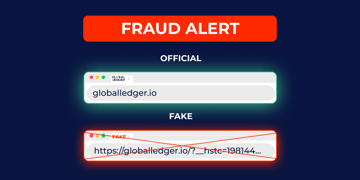 Global Ledger Alerts Users to Fraudulent Website Mimicking Its Official Site
Global Ledger is not affiliated with any .com domain. Our only official website is globalledger.io.