
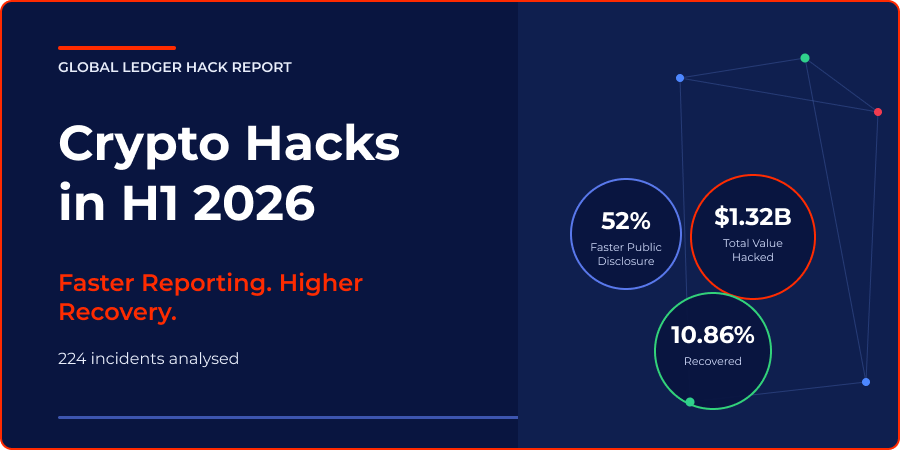
Explore key findings from 224 publicly disclosed crypto hacks in H1 2026, crypto crime trends, money laundering tactics and asset recovery strategies
In 2025, over $2.01 billion of stolen funds were routed through cross-chain bridges, accounting for nearly 49.75% of total losses and over 3× more than via mixers and privacy protocols, according to the Global Ledger Laundering Race report.
Going into 2026, this means suspicious activity may appear legitimate when viewed on a single blockchain while actually being part of a cross-chain laundering route.
This shift in laundering tactics was discussed at a roundtable in Bern hosted by Switzerland’s Money Laundering Reporting Office (MROS) and the Crypto Valley Association on 3 March 2026. The event brought together industry representatives to discuss SAR practices, emerging financial crime typologies, and the role of blockchain analytics in investigations.
Yulia Murat, Head of Regulatory Affairs at Global Ledger, shared insights on how these patterns affect investigations and crypto compliance frameworks. Below are the key takeaways and what they mean for AML teams in 2026.

MROS roundtable participants in Bern. Yulia Murat (Global Ledger) is second from the left.
MROS roundtable sum-up: what compliance teams should watch next in 2026
Cross-chain bridges are becoming a key laundering tool
One of the most important topics discussed during the roundtable was the growing role of cross-chain bridges in crypto laundering schemes.
Traditionally, illicit actors relied heavily on mixers and privacy services to hide the origin of funds. According to Global Ledger research, about 50% of stolen funds (or $763.48 million) were funnelled through mixers and privacy protocols in 2024.
Today, bridges are increasingly leveraged by bad actors for large-scale laundering, mainly due to their cross-chain infrastructure. More than $2.01 billion of stolen funds from 255 hacks in 2025 were routed through cross-chain bridges. It makes bridges one of the most common laundering routes. Why are they so popular among hackers?
Unlike mixers, bridges serve many legitimate purposes, including:
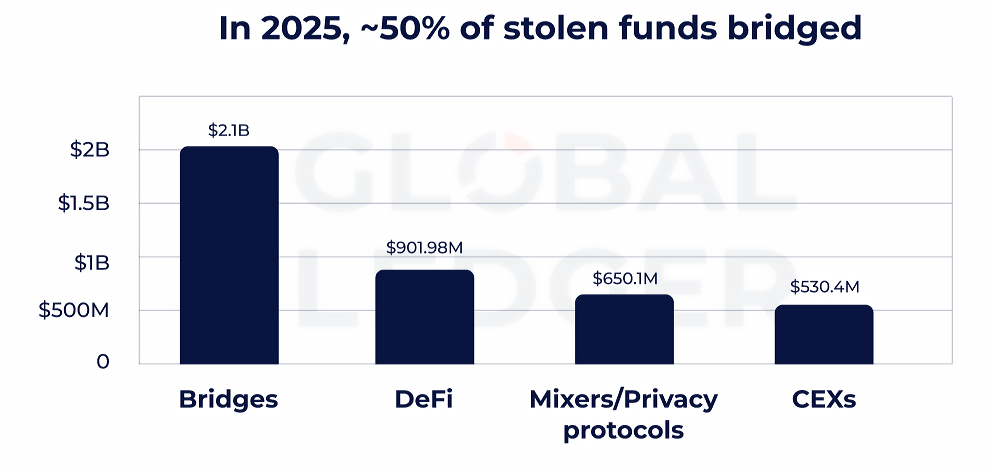
Cross-chain bridges dominate stolen funds laundering routes in 2025. Source: Global Ledger.
Laundering is becoming a multi-stage process
Another topic highlighted during the discussion was the increasing complexity of crypto laundering strategies.
Illicit actors rarely move funds directly to CEXs anymore. Instead, they rely on multi-stage transaction paths involving:
Global Ledger research shows that multistage laundering is used in ~99% of hacks, making risk harder to detect. For example, in H1 2025, there were three hacks (2.5%) where all funds went to a VASP or mixer in the first move, while in H2 2025 there were no such cases. This suggests fragmentation increased in H2 2025, with funds split into many smaller transfers. Such staged movements weaken the direct connection between the initial crime and the final cash-out point, making attribution more difficult.
Cooperation between regulators and industry is more important than ever
The roundtable also highlighted the importance of cooperation between Financial Intelligence Units (FIUs) and the crypto industry.
For compliance teams, this cooperation is especially important when it comes to Suspicious Activity Report (SAR) submissions and financial crime investigations. Crypto-related SAR reporting can be challenging due to:
Besides, preparing clear SAR submissions often requires reconstructing transaction paths and providing supporting on-chain evidence, which is where blockchain analytics play a key role.
How blockchain analytics helps detect crypto money laundering
To address these risks, compliance teams should increasingly rely on blockchain analytics platforms for transaction monitoring and investigations.
Effective crypto compliance frameworks today include:
With the Global Ledger KYT and KYB solution, your compliance team can:
Conclusion
As discussed at the MROS roundtable, crypto laundering is shifting toward cross-chain bridges and multistage transaction paths, making illicit flows harder to detect using “single-chain monitoring”. This means suspicious activity may appear legitimate unless cross-chain behaviour and transaction clusters are analysed together.
Global Ledger provides real-time monitoring with AI-powered alerts, fund flow visualisation, and entity exposure reports to identify risks before funds reach your exchange for cash-out. Schedule a demo to see how our platform helps compliance teams detect and investigate suspicious crypto flows in real time.
FAQ