
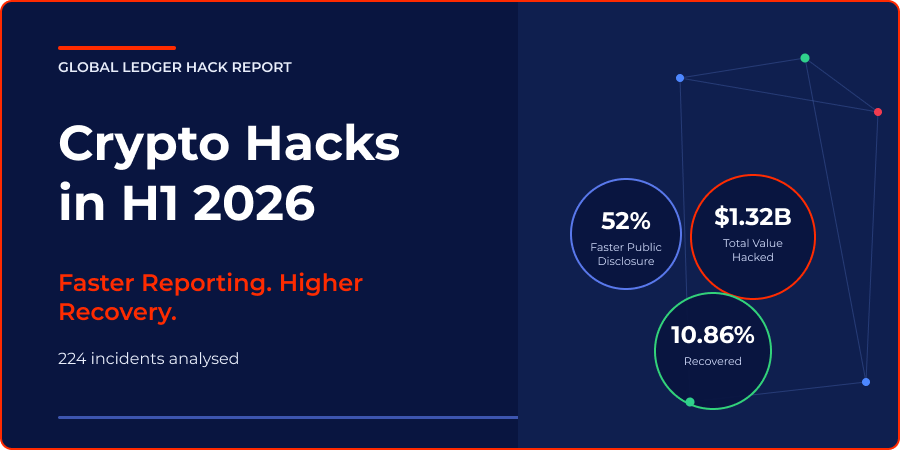
Explore key findings from 224 publicly disclosed crypto hacks in H1 2026, crypto crime trends, money laundering tactics and asset recovery strategies
Ask most people where women are underrepresented in crypto and they'll probably say tech or trading. Compliance is rarely the answer. Still, being present in the field and having influence over it are two very different things.
We spoke with women working across crypto compliance and regulation to better understand why the diversity gaps persist. What they shared wasn't one big problem. It was several smaller ones, often invisible, that add up over time.
In this article, we explore five of these gaps and what can help address them.
5 Main Gaps Behind Gender Imbalance in Crypto Compliance
1. Being in the Room Isn't the Same as Having a Say
Women are already actively working in compliance and regulation, but this does not always mean they are shaping decisions. There is still a gap between being part of the system and having real influence within it.
Delphine Forma, Head of Policy Europe & UK at Solidus Labs, has seen this pattern in both traditional finance and crypto:
In banking, compliance and legal are very much dominated by females, but the top management remains male. Whereas in crypto, I was very much surprised to see that compliance and legal was very male-oriented.

This gap has practical consequences. According to the Global Ledger Laundering Race report, over $4 billion were stolen in 2025. Financial crime moves fast, and compliance decisions need to move with it. Getting those decisions right requires different perspectives and experiences behind them. For many women in the field, the motivation to contribute goes beyond career. It is about making a real impact.
I've always believed in human rights and improving the world we live in. I became disappointed by the limited impact of international institutions. So I chose a different path: fighting financial crime. If you cut the money from criminals, you create a real impact.
Having presence in the field is a start, but real influence comes from being involved in decisions earlier and being trusted to shape them. That means building credibility over time and showing up in strategic conversations.
The good news is that this shift is already happening. As regulatory requirements grow, compliance is becoming a more central and high-stakes function. As a result, the field is attracting and recognizing more talent regardless of gender.
Female leaders in compliance is something that I have observed for a long time, and strengthening regulations only reinforce this tendency.

2. Structural Barriers Still Shape Who Leads
Progression into leadership is not always defined by talent or experience. Access to networks, how promotions are decided, and who gets visibility in strategic roles all play a role.
Amélie Malmaison, President of AWIC France and Senior Compliance Advisor, describes the challenges directly:
Women face structural hurdles, including limited access to networks, bias in promotion, and misperceptions of risk aversion. Mechanisms to address this include targeted mentorship and sponsorship, bias-aware promotion frameworks, leadership training, and clear career pathways.

Individual effort only goes so far. How opportunities are structured matters just as much. Access to networks, promotions, and leadership paths needs to become more transparent and inclusive.
Women’s influence requires more than talent — it needs structural change: inclusive recruitment, transparent decision-making, mentorship, and a culture that values diverse perspectives. Flexible work arrangements are essential: women can be fully committed without adhering to standard hours. Equally important is learning to work with men.
I’ve found it very rewarding — many have given me excellent advice that I’ve applied to grow professionally, which shows how collaboration across genders can strengthen careers.
3. Confidence and Visibility Gap
Many women hesitate to step forward, even when they have the skills and experience to do so. Over time, that hesitation affects how visible they are and how their work gets recognized.
So what holds women back? Often it comes down to self-confidence. Many women “second-guess” themselves before going for an opportunity, while men tend to just try. On top of that, there is often a reluctance to self-promote, which means good work goes unnoticed more often than it should. And the numbers reflect that: around 11.2% of Web3 startup founders are women, and just 8.6% of crypto startups are female-led.
Women need clear decision-making authority, recognition of expertise, and visibility in strategic initiatives. Mentorship is critical: women often hesitate to “sell themselves,” and guidance from mentors helps build confidence and impact. Listening to others’ experiences makes this process even more powerful.
4. Support Networks Are Still Underused
Women often develop strong expertise on their own, but do not always use support networks in the same way that structured male networks operate. This affects visibility, shared opportunities, and collective growth.
We have a tendency not to support each other in the same way men do.
5. The Gap Starts Before Careers Even Begin
The gender gap in crypto does not start at the hiring stage. It begins earlier, with who chooses to enter tech and finance in the first place. These fields have historically been male-dominated, which means fewer women enter the pipeline and representation in leadership reflects that later on.
Hannah Zacharias, Head of Regulatory Affairs at 21 Analytics, explains how this connects to business performance:
Positioned at the intersection of technology and finance, the crypto industry has traditionally been male-dominated, underscoring the demographics of the fields it grew out of. Research shows companies that are more gender diverse outperform their peers' financially.
So web3 players that strive for a gender balanced workplace can have a significant strategic advantage. Leveraging women professionals can help build more successful products and use cases in this innovative industry.

Conclusion
Women are entering compliance and regulation, building communities, leading discussions, and strengthening how the system works in practice. The proportion of women in the field is growing, but access to real influence still requires changes that go beyond individual effort.
What helps bridge the diversity gap:
- Representation alone is not enough — access to leadership positions matters.
- Strong communities and mentorship accelerate growth.
- Visibility creates more opportunities for women in the crypto compliance space.
Being a woman in this space is not a limitation, but a strength:
In these conversations, being a woman is a strength — this is also because many senior regulators are women. I have experienced great synergies when fostering such relationships, with both men and women, and I firmly believe that women have a great future in compliance & regulation.
At Global Ledger, we believe that expertise should define influence, not gender. Compliance decisions should be driven by knowledge and insight. This approach influences how we design our tools and support different stakeholders across the industry.
For regulators and government agencies, we provide tools and expertise to support supervision of crypto market participants, prevent illicit activity, achieve effective control and accountability of entities, and establish effective tracking of digital asset flows.
For compliance teams, we help detect exposure early with KYB and KYT solutions, combining entity risk insights, real-time monitoring with AI-powered alerts, and fund flow visualization.