

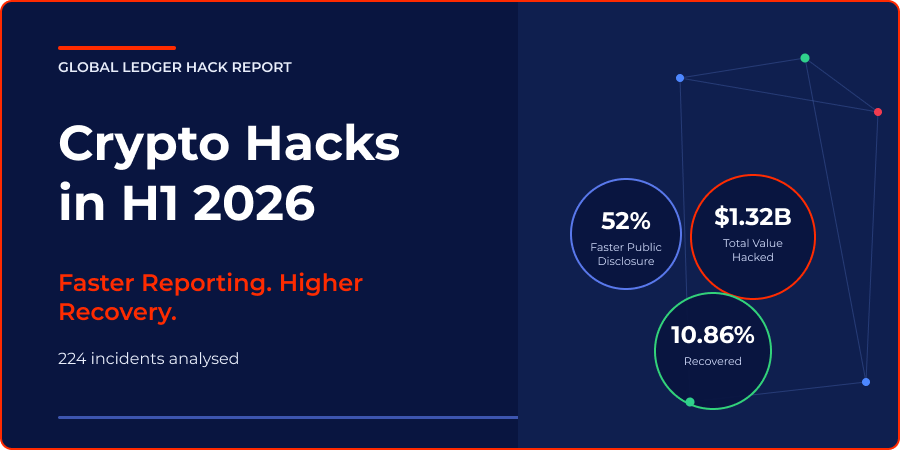
Explore key findings from 224 publicly disclosed crypto hacks in H1 2026, crypto crime trends, money laundering tactics and asset recovery strategies
Most conversations about crypto scams center on individual victims: people who clicked the wrong link, trusted the wrong token, or responded to a fake giveaway. That picture captures one part of reality — but it leaves out the institutional layer entirely.
Crypto exchanges, OTC desks, and financial institutions face different types of crypto scams: more targeted, more technically sophisticated, and with dramatically higher stakes per incident. A single breach can mean an entire operational wallet is emptied, a counterparty network is disrupted, or a regulatory process that follows the incident for years.
This article breaks down the six most dangerous types of crypto scams for B2B businesses today: what each one is, where it comes from, why it creates significant risks for companies, and what practical steps can be taken right now to address it.
Common Crypto Scams Targeting Businesses in 2026
According to Global Ledger's research across 255 incidents in 2025, total crypto losses reached $4.04 billion. In April 2026 alone, hackers stole $641.67 million across 25 major cases analyzed by Global Ledger. It is the highest monthly total this year and one of the largest since the Bybit hack.
Below is a crypto scams list of the six types that create the highest risk for B2B platforms today.
1. Malicious Approvals
Malicious approval attacks target the authorization process rather than the blockchain itself. Attackers either embed a fake interface into a platform's transaction approval process or manipulate the underlying transaction details within a multisig flow — so the person responsible for signing sees what appears to be a legitimate transaction, but is actually authorizing something entirely different.
The mechanism is as follows: the attack doesn't need to break cryptography. It just needs the person holding the keys to approve the wrong thing.
What do the crypto scams statistics show?
According to Global Ledger's analysis of 255 hacks in 2025:
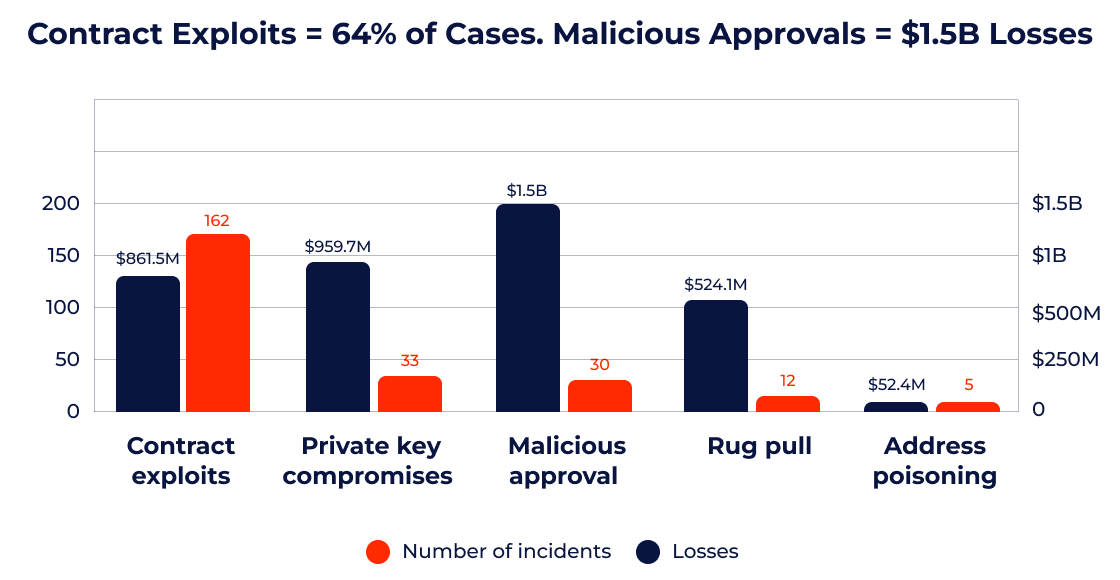
Despite fewer cases, malicious approvals caused the highest losses. Source: Global Ledger
Where is the main risk hidden?
Individual users don't run multisig approval workflows or internal signing environments that control company funds. This attack vector is built specifically around corporate authorization processes. The failure doesn't happen on the blockchain — it happens in the trust placed in the interface.
What you can do now to minimize the risk
- Require independent, off-system verification of every high-value transaction with all transaction details.
- Treat wallet infrastructure vendors as operational counterparties, not utility services.
- Never rely on a single interface layer as the final check on a high-value transfer.
2. Smart Contract and Bridge Exploits
Smart contract exploits target logical vulnerabilities in on-chain code: DeFi protocols, bridge contracts, and external protocol dependencies. Attackers identify a flaw — often quietly, sometimes weeks in advance — and then execute a fast, large-scale drain.
Bridge exploits specifically target cross-chain messaging layers, where validation logic is more complex and historically less audited than single-chain protocols. This is one of the most commonly occurring types of hacks.
What do the crypto scams statistics show?
According to Global Ledger's research:
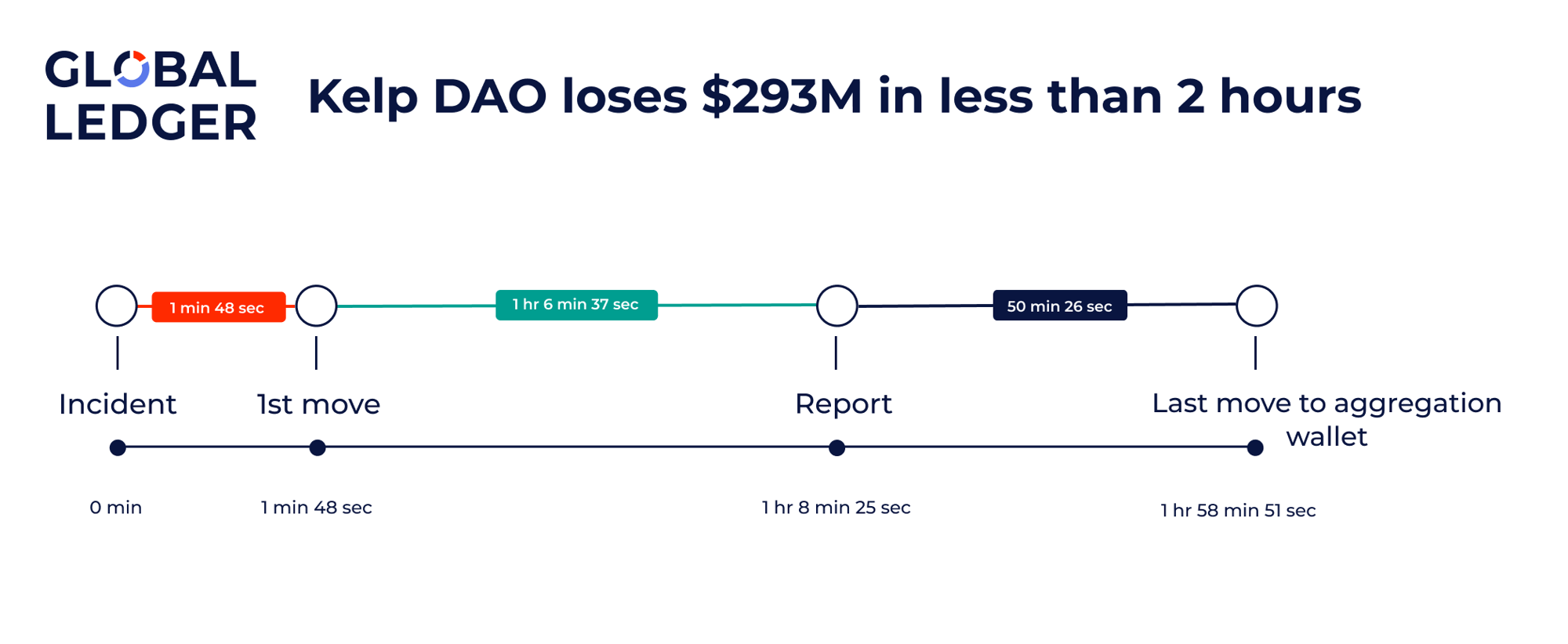
KelpDAO hack timeline
Where is the main risk hidden?
VASPs commonly hold liquidity in DeFi protocols and depend on bridges for cross-chain operations. This creates direct capital exposure: when the protocol is exploited, the business's funds are at risk.
Bridge attacks also create multi-chain complexity: losses spread across Ethereum, Arbitrum, Solana, and other networks simultaneously, which slows coordinated response.
What you can do now to minimize the risk
- Continuously monitor protocols and bridges with KYT solutions where your platform holds liquidity or routes transactions.
- Flag cross-chain activity as higher risk by default.
- Configure alert thresholds for unusual fund movements.
- Update risk models with bridge- and mixer-specific patterns.
3. Private Key Compromise
The private key compromise vector doesn't attack the blockchain — it attacks the credentials that control access to it. Attackers obtain private keys, seed phrases, or API keys through credential theft, internal security failures, or compromised infrastructure. Once they hold the keys, they hold the wallet. And they move immediately.
What do the crypto scams statistics show?
According to Global Ledger's research:
Where is the main risk hidden?
Centralized exchanges are the primary target because they concentrate high-value credentials in operational environments. One compromised key can expose the entire hot wallet balance.
The Bybit, Coincheck, KuCoin, and BtcTurk incidents all involved private key or hot wallet credential compromise as part of the attack chain.
What you can do now to minimize the risk
- Minimize hot wallet exposure; enforce strict segmentation between operational funds, company reserves, and customer assets.
- Apply behavioral monitoring to signing patterns — not only blacklist-based screening.
- Treat key-management infrastructure as a primary risk surface, with the same controls applied to critical systems.
4. Rug Pulls and Ponzi Schemes
A rug pull occurs when a project's developers attract funds — from liquidity providers, investors, or users — and then withdraw everything and disappear. The project may appear functional and even generate early returns before the exit. By the time the withdrawal happens, the funds are gone and the team is unreachable.
Ponzi schemes follow a different structure but arrive at the same outcome. They generate returns for early participants using funds from new ones, creating the appearance of a legitimate investment product. The scheme holds together only as long as new capital keeps coming in — and collapses the moment it doesn't.
Both rely on the same fundamental gap: the people running the scheme know it's fraudulent; the businesses and users providing funds do not. Among the most typical crypto scams in this category, rug pulls and Ponzis remain persistently active despite growing market awareness.
What do the crypto scams statistics show?
According to Global Ledger's research:
Where is the main risk hidden?
For B2B platforms, the exposure is primarily through counterparty risk. Exchanges that list or provide liquidity for fraudulent projects can face regulatory questions, user claims, and reputational consequences. OTC desks and liquidity providers that onboard rug-pull tokens before the exit can end up holding worthless assets. It can be even worse: facilitating laundering flows from the fraud without realizing it.
What you can do now to minimize the risk
- Apply KYB-level sanctions screening to new counterparties before providing liquidity or listing.
- Monitor on-chain concentration and developer wallet behavior for early exit signals.
- Maintain documented due diligence trails for any asset or project onboarding decision.
5. Governance Failures & Internal Fraud
This category is not a technical hack but an institutional failure. Governance breakdowns occur when internal controls are weak enough that insiders can misappropriate funds, hide liabilities, or grant hidden privileges to related entities.
The fraud typically runs undetected until the platform approaches financial collapse or external scrutiny forces disclosure.
What do the crypto scams statistics show?
Where is the main risk hidden?
This is the only scam type that doesn't primarily damage the fraudulent platform itself. It damages every B2B counterparty that has exposure to it.
Governance failures are arguably the most dangerous crypto scams for B2B precisely because they cannot be detected through blockchain monitoring alone. They require enhanced counterparty due diligence, meaningful proof-of-reserves verification, and ongoing oversight of related-party structures.
What you can do now to minimize the risk
- Treat major counterparties as active risk exposures requiring ongoing KYB verification — not one-time onboarding checks.
- Look for signals of hidden liabilities: inconsistent reserve disclosures, undisclosed related-party relationships, irregular governance structures.
- Avoid having critical operational dependencies — settlement, liquidity, custody — concentrated in a single counterparty whose governance you cannot independently verify.
6. Impersonation & Crypto Recovery Scams
Impersonation scams targeting businesses work differently from retail phishing. Fraudsters copy the branding, domain, and documentation of legitimate blockchain analytics firms to target victims of prior crypto losses. They pretend to be fund recovery specialists, legal representatives, or compliance service providers.
For businesses specifically, the attack surface is different. Operational and compliance staff can be approached through spoofed vendor communications, fake compliance service offers, or fraudulent outreach impersonating law firms or investigators.
There is a structural reason why this happens: the firms best positioned to help after a breach — blockchain analytics companies with forensic capabilities — are also the ones most often impersonated. Their credibility is precisely what makes copying their brand name effective.
What do the crypto scams statistics show?
Where is the main risk hidden?
Three parties are affected simultaneously, and that is what makes this scam type structurally damaging rather than just costly.
The victim has already lost funds and is now searching for help under time pressure — the exact conditions that reduce caution and increase willingness to trust quickly.
The legitimate firm being impersonated loses trust it didn't damage, because every person defrauded through the fake site associates the experience with the real brand.
And the industry as a whole loses a critical layer of trust: the people most in need of blockchain forensics support become reluctant to engage any firm that claims to offer it.
What you can do now to minimize the risk
- Set up monitoring for domain variations of your own brand and key vendor brands.
- Train operational and compliance staff to verify vendor identities through direct channels — never through links sent inbound.
- Establish a clear internal protocol for how third-party service providers are engaged after an incident.
- If you identify impersonation of your brand or a vendor you rely on: act fast, document the fraudulent domain or communication, notify affected users through official channels directly, and report to the relevant authorities.
Examples of Crypto Scams Creating the Highest B2B Risk
Knowing the types is one layer of understanding. Seeing how they have played out — historically and recently — is another.
The following cases represent the highest-impact incidents in crypto history, mapped to the scam types described above. The table runs from the most recent to the oldest, with the specific compliance and B2B risk each case created.
Top 6 historical incidents that matter for crypto businesses
Top 7 recent incidents (2024-2026) that matter for crypto businesses
Conclusion
The landscape of crypto scams has changed in ways that matter directly to businesses. The most dangerous types of crypto scams today are deliberate, technically sophisticated, and often specifically designed to exploit the exact processes that companies rely on: signing flows, approval chains, bridge infrastructure, and counterparty relationships.
For exchanges, VASPs, and financial institutions, awareness of the most common crypto scams is the starting point, not the defense. The practical layer is continuous monitoring, multi-hop tracing capability, counterparty due diligence, and clear escalation procedures.
While laundering has become faster and cheaper, compliance has not kept pace. Global Ledger closes that gap with real-time monitoring, cross-chain visibility, and enhanced due diligence that cover the full picture behind transactions and entities.
Quiet risk is harder to spot. Preparation helps — and you don't have to do it alone.