
Explore crypto AML transaction monitoring rules, red flags, and 6 practical scenarios, backed by Global Ledger's analysis of 99 exchanges.
A customer asks to withdraw 48,000 USDT on Tron. The destination address doesn't appear on any sanctions list, so a list-only sanctions screening API returns "no match" in milliseconds.
Now look two hops back. A third of the funds that address has received came from a designated exchange.
Now the same withdrawal looks very different. And that's exactly the gap crypto screening has to close. A list check can tell you whether an identifier is listed, but not where the funds came from, where they're going, or how close they sit to a sanctioned entity.
Even OFAC acknowledges that its list of digital currency addresses is not likely to be exhaustive.
Global Ledger's High-Risk Benchmark of 99 centralized exchanges (CEXs) points the same way: in 2025, sanctions exposure sat an average of 3.06 value-weighted hops away.
This article explains what a crypto sanctions screening API needs to detect, what its response should return to your policy engine, how that result turns into an allow, review, hold, or reject decision, and how to evaluate an API before you integrate it.
What Is a Sanctions Screening API for Crypto?
In other words, the API produces a risk result, and your institution makes the decision. It also means the API doesn't need an endpoint literally called "sanctions" to support sanctions screening.
The value of the API is the sanctions intelligence it makes usable inside the transaction workflow, not the name of the endpoint that delivers it.
To see why that matters, let's start with what a direct list match can and can't do.
Why Is Direct Wallet Matching Not Enough?
Sanctions are where screening gaps cost the most. Global Ledger's High-Risk Benchmark report analyzed $36.28 trillion in flows across 99 CEXs, and sanctions came out as the largest risk category: $74.09 billion in combined exposure across 2021–2025, and 62.2% of all risky inflows by 2025.
Direct matching is the first layer of defense. OFAC has been adding digital currency addresses to the Specially Designated Nationals (SDN) List since 2018, and you can look them up in its Sanctions List Search through the "ID #" field. That field doesn't use fuzzy logic, so it returns exact matches only.
That makes direct matching precise, but narrow. In its virtual currency guidance from October 15, 2021, OFAC notes that unlisted addresses can pose sanctions risk too, for example when they share a wallet with a listed address or have transacted with one. To find them, it points to blockchain analytics and historical lookbacks.
Global Ledger's benchmark report data shows just how far that risk can sit from the address you're screening:
-
In 2025, sanctions-related exposure averaged 3.06 value-weighted hops, compared with 1.80 hops for hack-related exposure.
-
Across all risk categories, average exposure stayed below three hops.
-
Sanctions-related deposits were also smaller, averaging $5,772 in 2025 against $20,137 for hacks. Value thresholds alone are unlikely to catch them.
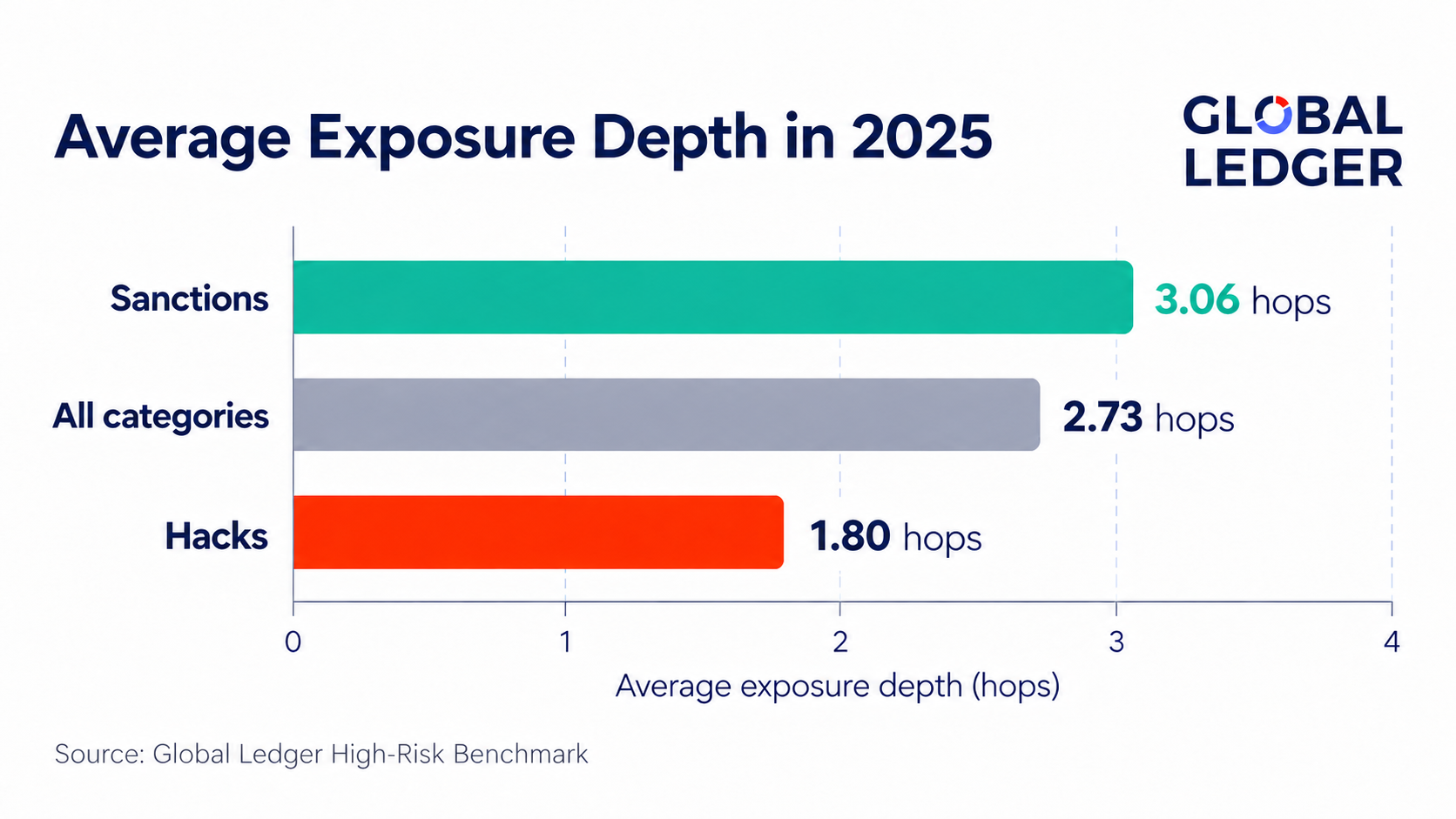
Average Exposure Depth in 2025
The benchmark followed BTC, ETH, and USDT on Tron from 2021 to 2025 and counted how close funds came to known high-risk entities, up to five hops out. If an exchange shows up in that data, part of its flows connects to a sanctioned entity within those hops. It doesn't mean the exchange or its customer knew, and only an investigation can settle that.
For compliance teams, the takeaway is simple: "no match" tells you something about the list, not about the funds. For technical teams, it means the API response has to carry far more than a boolean.
What Should a Crypto Sanctions Screening API Detect?
Think of the screened address as the middle of a chain. A useful API has to describe that chain in both directions, say who controls the links in it, and show how far away the sanctioned one is.
In practice, that comes down to eight capabilities:
-
Direct sanctions exposure. The address or counterparty is attributed to a sanctioned entity or matches a listed identifier.
-
Indirect sanctions exposure. Funds moved to or from the address through intermediary wallets or services linked to a sanctioned entity.
-
Source of Funds. Where incoming value originated, broken down by entity and risk category.
-
Use of Funds. Where outgoing value went, which matters most for withdrawals and counterparty checks.
-
Entity attribution. Who actually controls the address, including services that relaunch under new names.
-
Exposure depth. How many hops separate the address from the sanctioned source.
-
Changing status. New designations or new attribution that change an earlier result.
-
Decision-ready context. Share, amount, direction, and category, structured so a policy rule can read them.
Two of these are where list-based setups most often fall short: coverage and change over time. Coverage is the simpler one. In the benchmark, 81% of sanctions-related inflows across 2021–2025 moved in USDT, so an API with thin stablecoin coverage on Tron would miss most of that flow, even though USDT itself is not a red flag.
Change over time is harder, and Grinex shows why.
After OFAC designated the exchange on August 14, 2025, regulated platforms pulled back: the share of Grinex volume passing through CEXs fell from 49% to 14.5%. Grinex itself barely slowed. Its monthly volume dropped by only about 12.8%, and it processed another $9.25 billion by April 15, 2026. The money kept moving through less visible routes, and a setup that only reacts to the designation itself catches the direct flows and misses the rest. That is where indirect exposure, attribution updates, and rescreening earn their keep.
None of this helps, though, if the API flattens it into a single flag before it reaches your policy engine.
What Should the API Response Return to Your Policy Engine?
A good response lets your policy rule tell a sanctioned counterparty apart from a small, distant link. Here's what it should include and why.
A risk score compresses all of this into a single number. That's useful for triage. But when you have to choose between hold and reject, and later explain that choice in a case file, you need to know which component drove the score.
Once you know what the response should contain, the next question is where it sits in the transaction flow.
How Does Real-Time Sanctions Screening Work in a Transaction Workflow?
Real-time sanctions screening works best at the points where funds can still be stopped: before a deposit is credited, before a withdrawal is broadcast, and when a new counterparty address is added.
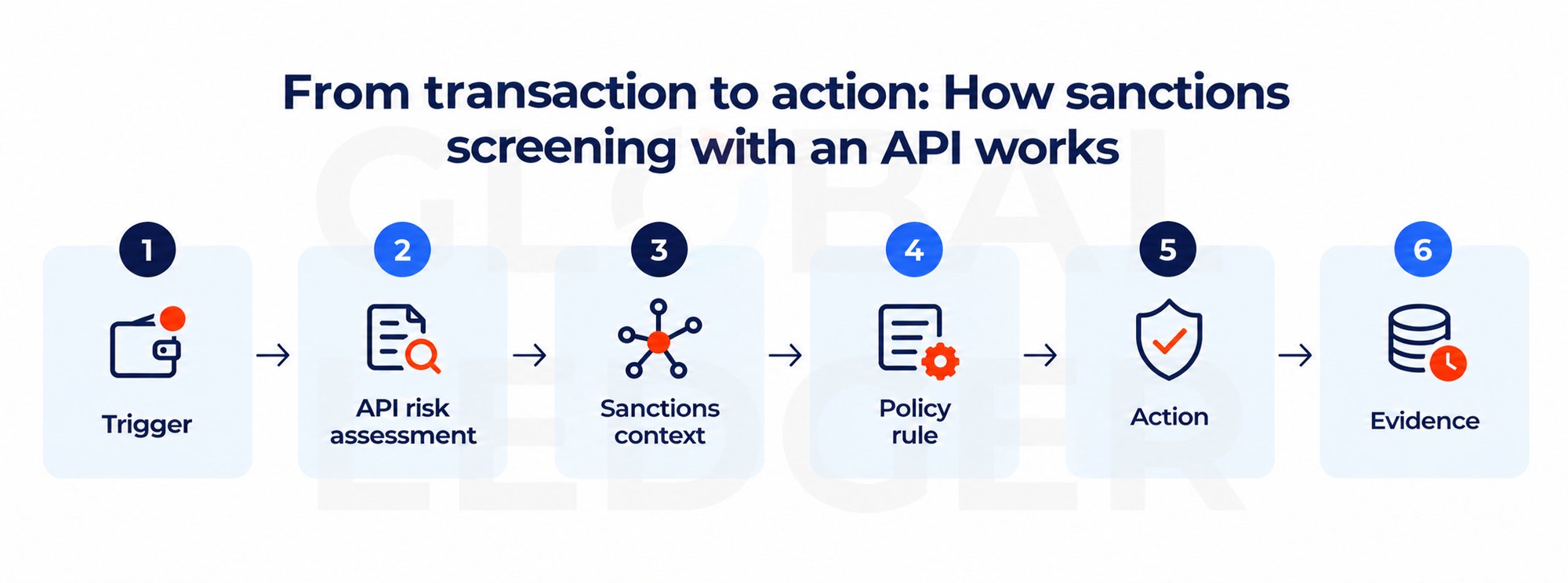
At each of these points, the sequence looks the same:
-
Trigger: a deposit is detected, a withdrawal or transfer is requested, or a counterparty address is added.
-
API risk assessment: the address or transaction hash goes to the API, which returns a risk report.
-
Sanctions context: the policy engine reads sanctions-related entries in entity risk, Source of Funds or Use of Funds, with depth, share and amount.
-
Policy rule: the institution's rule maps that context to an action.
-
Action: allow, review, hold, reject, or request additional approval.
- Evidence: the response, rule version, threshold, analyst notes and final action are retained.
From transaction to action: How sanctions screening with an API works
Global Ledger's own integrations follow this pattern.
In the Dfns integration, the policy engine queries Global Ledger before a transaction is broadcast. If the score exceeds the client's threshold or an alert fires, the transfer is blocked, escalated, or sent for additional approval.
In IBM Digital Asset Haven, every blocked or escalated transfer is tied to a risk score, a threshold, and a configured policy rule.
Worked example
Let's go back to the withdrawal from the beginning. Exchange X receives withdrawal W: 48,000 USDT on Tron, going to destination address D.
-
Direct check. The destination address doesn't match any listed address, and no known entity controls it. It appears to be a self-hosted wallet.
-
Source of Funds. The API reveals that 34% of the funds received by this address can be traced to a sanctioned exchange two blockchain hops away.
-
Policy rule. Based on its risk assessment, the exchange rejects and reports transactions involving directly sanctioned entities as required. For indirect exposure, it considers the share of affected funds and their distance from the sanctioned entity. Cases meeting its calibrated risk criteria are held for review. Lower-risk cases are allowed and monitored.
-
Outcome. The withdrawal is put on hold. An analyst reviews the customer's relationship with the destination address, documents the rationale, and makes the final decision.
The 34% exposure and two-hop distance are illustrative, not recommended thresholds. Each exchange sets its own limits through risk assessment and backtesting. Legal obligations also vary by jurisdiction. US persons, for example, must report rejected transactions to OFAC within 10 business days, while EU and UK rules apply their own ownership, control, and reporting tests.
In practice, most screening failures come from skipping one of these steps.
Common Failure Modes in Automated Sanctions Screening
Automated sanctions screening tends to break down in four familiar ways:
Boolean-only integration. The system stores "match" or "no match" and throws away depth, share, and entity.
-
One-time screening. Results are never revisited after a new designation or attribution, even though OFAC's guidance stresses rescreening.
-
Blocking every indirect link. Treating proximity as guilt floods the review queue and rejects legitimate activity.
-
Post-execution screening. The alert arrives after the funds have already left.
The good news is that most of these gaps show up early, during vendor evaluation.
API Evaluation Checklist for Sanctions Transaction Screening
When comparing APIs for sanctions transaction screening, check whether the API:
-
Detects direct and indirect exposure, not only listed addresses
-
Returns Source and Use of Funds by entity and category, with shares
-
Reports exposure depth and keeps entity risk separate from the score
-
Covers your chains and assets, including USDT on Tron
-
Meets your latency budget for pre-transaction screening
-
Alerts when designations or attribution change
-
Leaves thresholds and actions to your policy engine
- Retains request history and exportable reports, with documented methodology
None of these criteria depend on what the endpoints are called. What matters is what the response contains, how fast it arrives, and what record it leaves for your auditors and banking partners. An API built for general AML or KYT risk scoring can meet all of them, as long as sanctions exposure is part of its risk data.
How Global Ledger API Supports a Sanctions Screening Workflow
Global Ledger API works this way. Sanctions intelligence is built into the same risk reports it returns for AML and KYT checks, so it can be used as part of a crypto sanctions screening workflow without a separate sanctions endpoint.
Each report includes the GL Score, a 0–100 rating built from entity risk, Source of Funds risk, Use of Funds risk, and address risk, with funds traced back to a recorded depth. Sanctioned entities push the score high even when exposure is minimal. Because the report also breaks Source and Use of Funds down by entity and risk label, your policy engine can see which sanctions-related exposure drove the score and apply its own rules to it.
On top of that, Global Ledger KYT adds ongoing monitoring, alerts based on new sanctions data, and an exportable history of alerts, API calls, and score changes for audits.
Conclusion: What Makes a Sanctions Screening API Worth Integrating
A crypto sanctions screening API earns its place in your stack when its output can support a defensible decision. A list match tells you whether an identifier is listed. Everything else depends on where the exposure sits in the flow of funds, how far away it is, how much value it carries, and whether any of that has changed since the last check.
So screen before funds move, look at the components behind the score, let your own calibrated policy choose the action, and keep the evidence that shows why.
Build crypto sanctions screening into your workflow. Explore how Global Ledger API can add real-time crypto risk intelligence to your sanctions screening workflow.
FAQ