

Mercado Bitcoin hack: $49M stolen, $11.8M frozen, 106 BTC untouched. Where the funds went and what exchanges should monitor in hack-linked deposits.
Brazilian exchanges going through authorization as virtual asset service providers (PSAVs) now have to show the Banco Central do Brasil (BCB) that their anti-money laundering controls work in practice, not just on paper. Part of that is knowing where high-risk funds actually move: into the exchange or out of it.
Global Ledger identified $82.2 million in combined high-risk exposure associated with six Brazilian cryptocurrency exchanges between August and November 2026. Almost all of it was USDT on Tron, and $76.73 million was leaving the exchanges rather than arriving.
Read on to see where the exposure was concentrated, how it compares with the High-Risk Benchmark, and what it means for transaction monitoring under Brazil’s new framework.
Where the $82.2 Million Was Found
Almost all of the exposure was concentrated in one asset on one network. USDT accounted for $80.19 million (97.6%), and $78.91 million of that was on Tron. BTC followed at $1.09 million (1.3%), then USDC at $0.57 million (0.7%), ETH at $0.24 million (0.3%) and TRX at $0.08 million (0.1%).
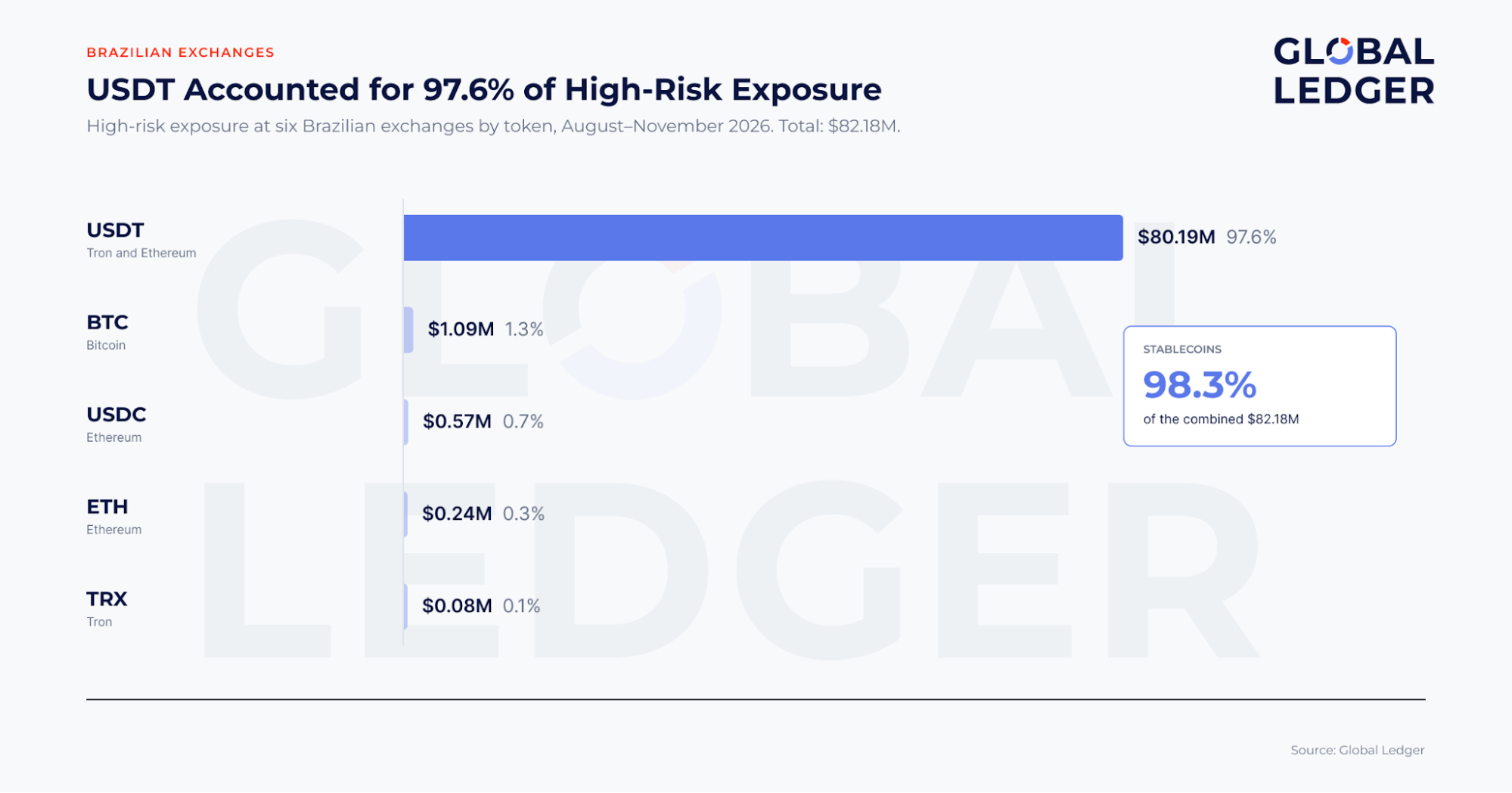
USDT accounted for 97.6% of high-risk exposure at six Brazilian exchanges
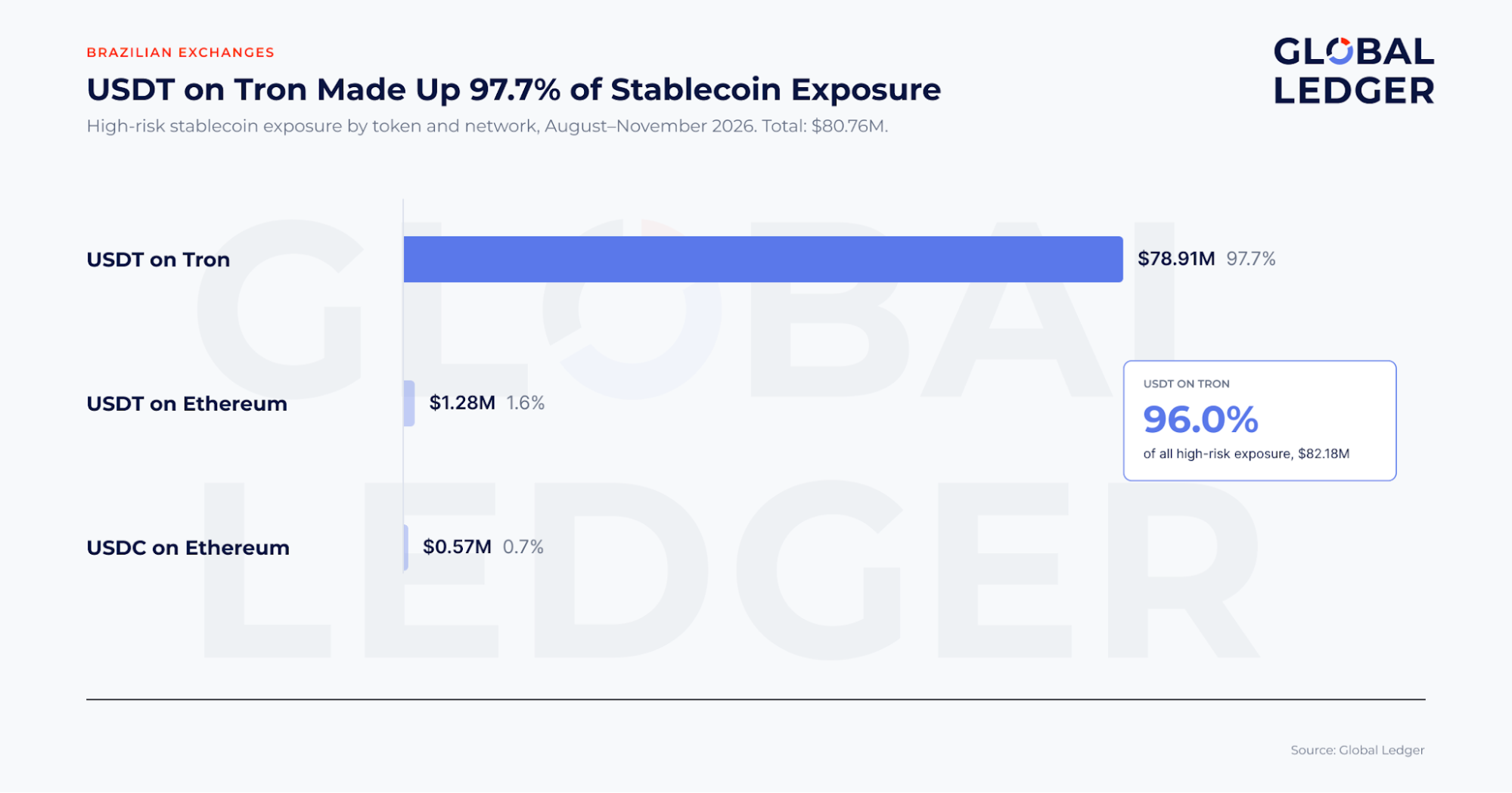
Within stablecoins, USDT made up 99.3% of the $80.76 million and USDC 0.7%. USDT on Tron alone was 97.7% of stablecoin exposure, while USDT on Ethereum added $1.28 million.
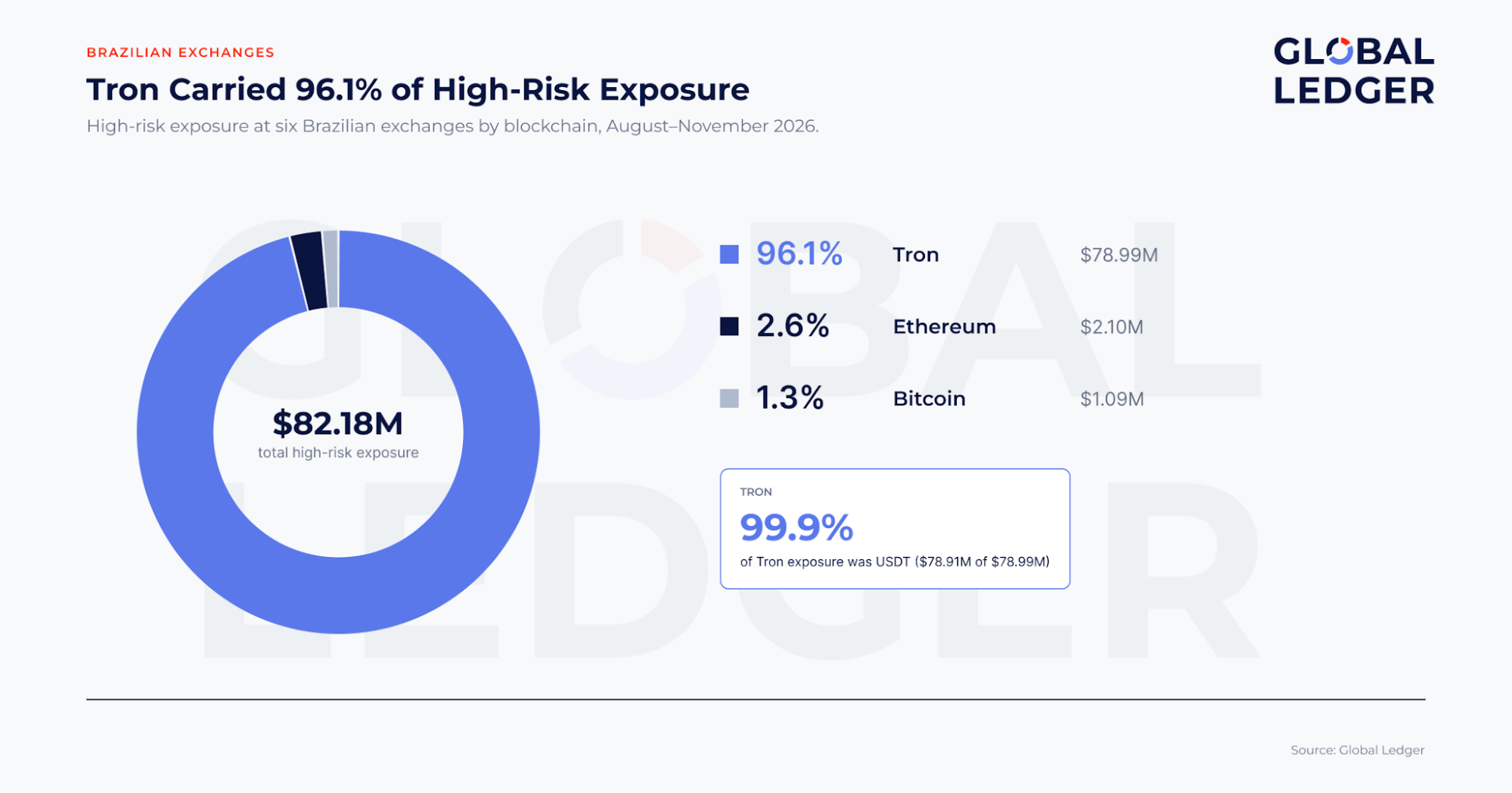
Tron carried 96.1% of high-risk exposure
By blockchain, Tron carried $78.99 million (96.1%), 99.9% of it in USDT. Ethereum carried $2.10 million (2.6%) across USDT, USDC and ETH, and Bitcoin $1.09 million (1.3%).
USDT on Tron made up 97.7% of stablecoin exposure
Exact values for each asset and network are given in the table below.
Most High-Risk Exposure Was Leaving the Exchanges
Of the $82.2 million, $76.73 million (93.4%) was outgoing and $5.45 million (6.6%) incoming. Across all analyzed assets, outgoing exposure was about 14 times higher than incoming exposure.
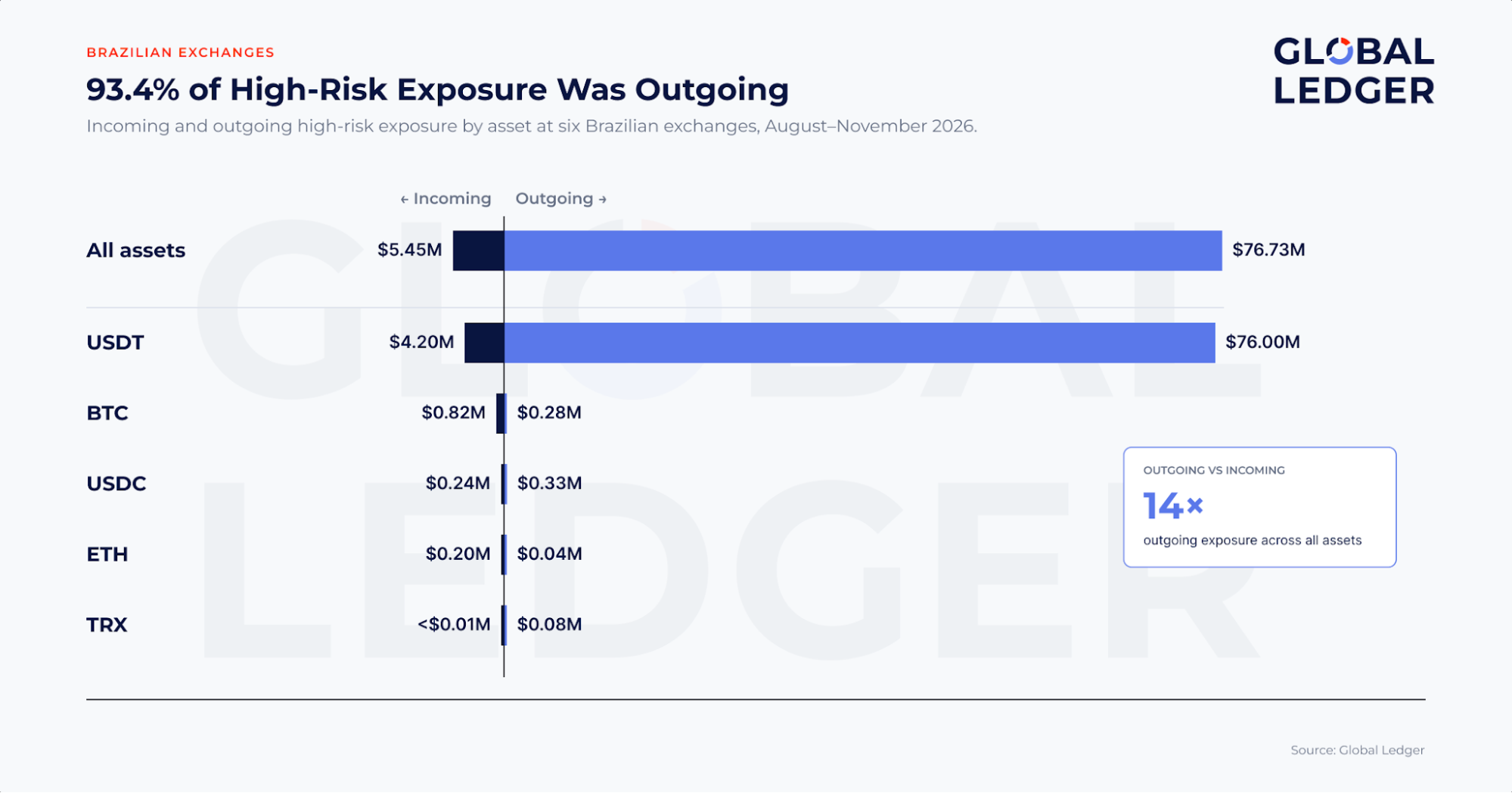
93.4% of high-risk exposure was outgoing
Stablecoins drove this result.
USDT had $4.20 million incoming and $76.00 million outgoing, 18.1 times more and the largest gap in dollar terms of any asset. Most of it was on Tron, with $74.98 million outgoing against $3.93 million incoming. On Ethereum, USDT exposure was $1.02 million outgoing and $0.26 million incoming, and USDC was closer to balanced, at $0.33 million outgoing and $0.24 million incoming. Across all stablecoins, 94.5% of exposure was outgoing.
Native TRX had the steepest ratio, with 264,260 TRX outgoing against 3,488 TRX incoming, about 76 times more. At $0.08 million, though, it barely affects the total. BTC and ETH went the other way: 13.18 BTC incoming against 4.48 BTC outgoing, and 114.98 ETH incoming against 23.89 ETH outgoing. Together they added $1.02 million of incoming exposure, against $4.43 million in stablecoins.
The direction changes what a compliance team has to look at.
Incoming exposure raises a question about the source of a customer’s funds at deposit. Outgoing exposure means funds left the exchanges for addresses linked to high-risk activity, which is a question about the use of funds and about where the exchange lets money go. Neither direction on its own shows that an exchange knowingly facilitated unlawful activity.
Brazilian Findings Follow the Global Shift Toward USDT on Tron
Global Ledger’s High-Risk Benchmark analyzed $36.28 trillion in cryptocurrency flows across 99 centralized exchanges between 2021 and 2025 and identified $187.75 billion in combined high-risk exposure.
Over those five years, the composition of high-risk exchange flows changed sharply. In 2021, BTC accounted for 83.1% of identified high-risk inflows, compared with 9.2% for USDT on Tron. By 2025, BTC’s share had fallen to 11.0%, while USDT on Tron had risen to 68.0%. USDT on Tron also accounted for 80.4% of high-risk outflows in 2025.
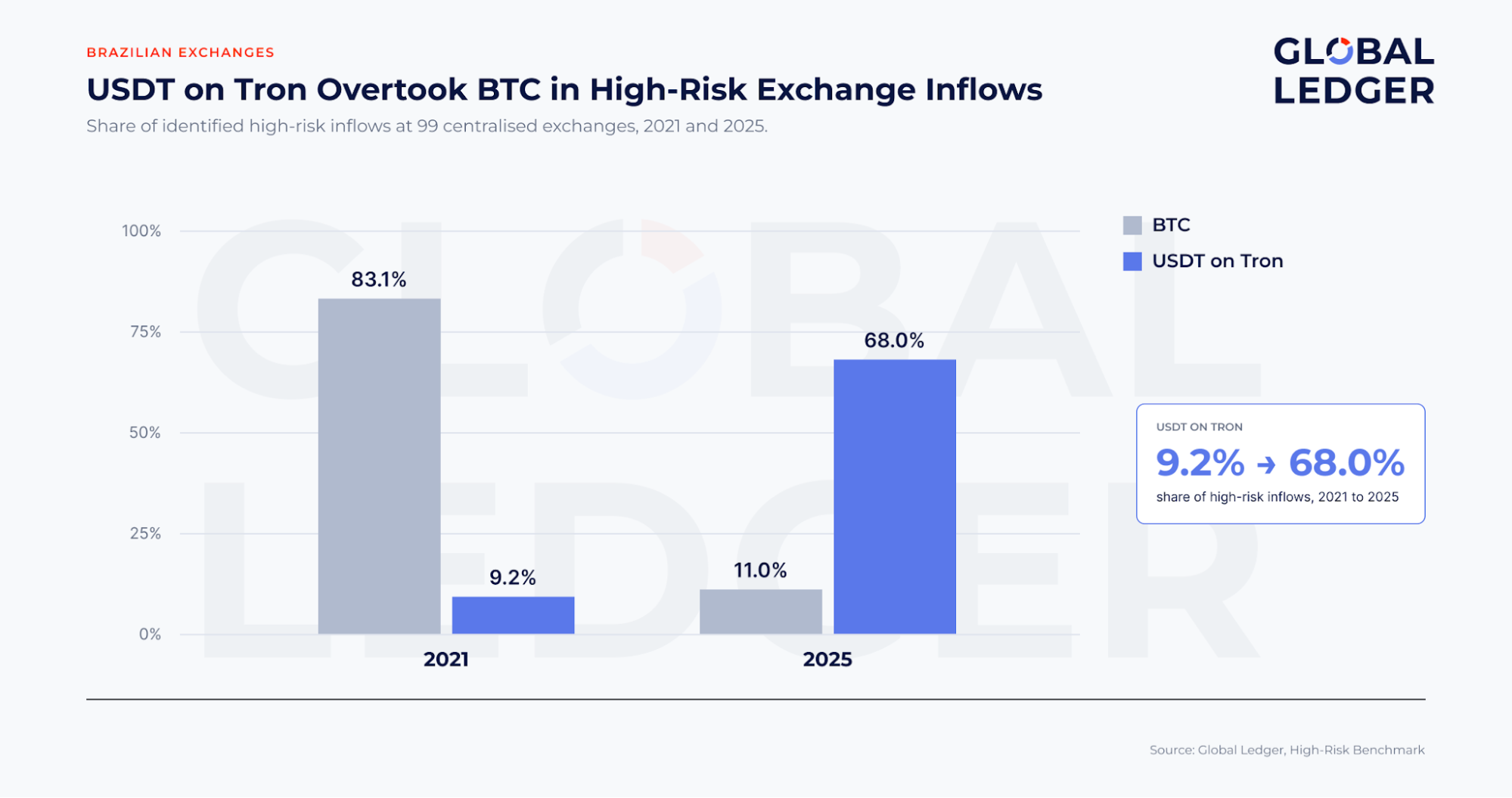
USDT on Tron overtook BTC in high-risk exchange inflows, 2021–2025
The Brazilian sample shows a similar pattern, with USDT on Tron at 96.0% of identified exposure. The 96.0% and 68.0% figures should not be compared directly, though. The studies cover different periods, exchanges and assets, and measure shares against different totals, so the Brazilian result does not show that concentration has grown since 2025. It shows that the pattern documented globally also appears in a recent regional sample. Our article on stablecoin AML compliance explains what drives that pattern.
What the Findings Mean for Brazilian PSAVs
Brazil’s framework for virtual asset service providers rests on Law No. 14,478/2022, Decree No. 11,563/2023 and Resolutions BCB 519, 520 and 521, in force since February 2, 2026. Providers that were already operating go through a two-phase authorization, as our overview of Brazil crypto regulation in 2026 explains.
After a favorable phase-one decision, a provider has 60 days to file phase two (IN BCB 704, art. 10).
The filing must include a reasonable assurance report on its PLD/FT controls (prevenção à lavagem de dinheiro e ao financiamento do terrorismo, Brazil’s term for anti-money laundering and counter-terrorist financing) from an independent auditor registered with the Comissão de Valores Mobiliários (CVM), Brazil’s securities regulator (IN BCB 739).
Several of the areas the auditor reviews connect directly to these findings.
- Transaction records. Records of payments, receipts and transfers have to identify the origin and destination of funds (BCB Circular 3,978, art. 30). In this sample, 93.4% of identified exposure was on the destination side of the transaction.
- Suspicious activity monitoring. The auditor checks that monitoring rules fit the provider’s operations and that the team can analyze every alert it generates. If an exchange screens deposits closely but checks withdrawals less carefully, its weaker checks fall where most of the high-risk exposure in this sample sat. Rules also need to separate token from network: USDT on Tron had 19 times more outgoing than incoming exposure, USDT on Ethereum about 4 times.
- Sanctions screening. Providers that contract relevant services must set up controls with those providers to identify sanctioned wallet addresses (Resolution BCB 520, art. 34). The Brazilian analysis did not break exposure down by risk category, so it does not show how much of it was sanctions-related. In the High-Risk Benchmark, however, 81% of sanctions-related high-risk inflows were in USDT, which makes screening of USDT addresses on Tron especially relevant for exchanges with USDT-heavy flows.
In each of these areas, the auditor will look for records that show the control in use. An alert on a withdrawal should rest on verified attribution of the counterparty rather than a wallet label alone, and the case file should keep the evidence the analyst saw at the time of the decision. Our phase two filing checklist shows how to organize that evidence, and the crypto AML transaction monitoring guide covers how to build the rules.
Conclusion: Monitor Withdrawals as Closely as Deposits
Across six Brazilian exchanges, identified high-risk exposure was concentrated in one asset on one network and moved mostly in one direction: USDT on Tron, leaving the exchanges. For PSAVs preparing phase two, that makes withdrawal monitoring, network-level rules for stablecoins and documented attribution part of the evidence the auditor and the BCB will expect to see.
Global Ledger supports this with real-time wallet and transaction risk scoring, including for USDT on Tron, sanctions screening, direct and indirect exposure detection, and Source and Use of Funds analysis. KYT alerts, Risk Reports and case files keep the on-chain evidence behind each decision in one place. Explore Global Ledger KYT or see AML controls for Brazilian PSAVs.