

Explore crypto AML transaction monitoring rules, red flags, and 6 practical scenarios, backed by Global Ledger's analysis of 99 exchanges.
In 2026, Travel Rule compliance is no longer just a data-sharing requirement. It is a core part of how VASPs prevent risk, meet AML obligations, and maintain regulatory approval.
Regulators no longer ask whether a VASP merely has a Travel Rule policy. They increasingly assess whether the policy operates effectively in practice: whether required originator and beneficiary information is obtained, verified where required, securely transmitted to counterpart institutions, exceptions are identified and escalated, and records are retained in a manner that supports supervisory review and audit. For firms still treating Travel Rule compliance as a documentation exercise, the gap between policy and operational implementation is closing fast.
In this article, you'll find out what the Travel Rule is, what compliance teams need to follow in practice, and what challenges VASPs face in 2026.
What Is the Travel Rule in Crypto?
The Travel Rule is a requirement under FATF Recommendation 16 that obligates Virtual Asset Service Providers (VASPs) to collect, verify, and transmit identifying information about the originator and beneficiary alongside crypto transfers above a defined threshold.
Originally introduced for traditional financial institutions, the Travel Rule was extended to virtual assets in 2019 as part of global AML standards set by the Financial Action Task Force (FATF). In this context, it is commonly referred to as the AML Travel Rule.
The AML Travel Rule requires VASPs to collect and transmit verified information about who is sending and receiving funds. This goes beyond basic customer identification — every qualifying transfer must be accompanied by required originator and beneficiary information, verified where required under the applicable legal framework.
What information must travel with the transaction?
When a VASP initiates a transfer, identifying information about both the sender (originator) and the recipient (beneficiary) must be passed to the receiving VASP at the time of the transfer. At minimum, this includes:
For the originator:
-
Full name
-
Account number or wallet address
-
One additional identifier (address, national ID, customer ID, or date and place of birth)
For the beneficiary:
-
Full name
-
Account number or wallet address
This is the minimum required information under the Travel Rule. Additional data or verification may be required depending on the jurisdiction and risk level of the transaction. For transfers below the threshold, basic information must still be collected, with verification required in higher-risk scenarios.
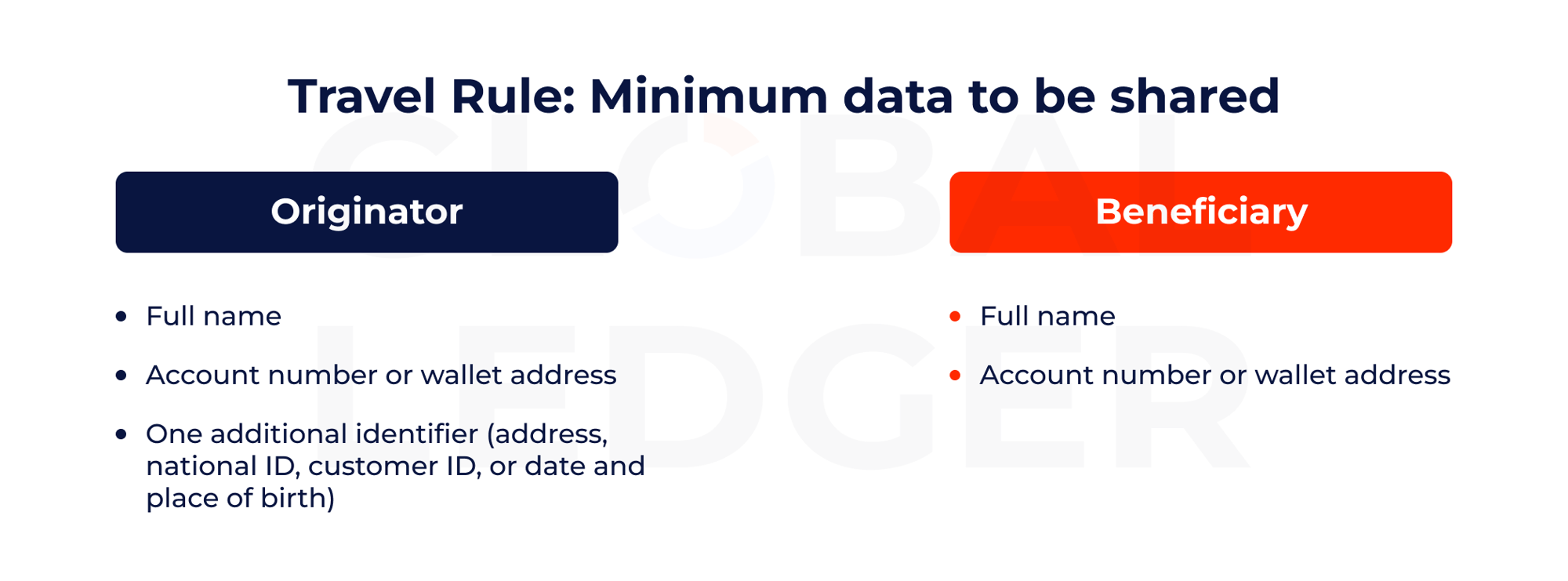
Travel Rule: minimum data to be shared. Source: Global Ledger
Why the Travel Rule matters beyond data collection
Travel Rule data gives regulators and VASPs the foundation to trace fund flows and support broader AML controls.
When properly collected and transmitted, the Travel Rule data enables compliance teams to:
-
Use verified counterparty data for sanctions screening against individuals, entities, and countries.
-
Support the identification of transfers linked to terrorist financing.
-
Enable consistent suspicious activity reporting (SAR) across counterparties.
-
Contribute to broader controls that prevent crypto assets from being used for money laundering.
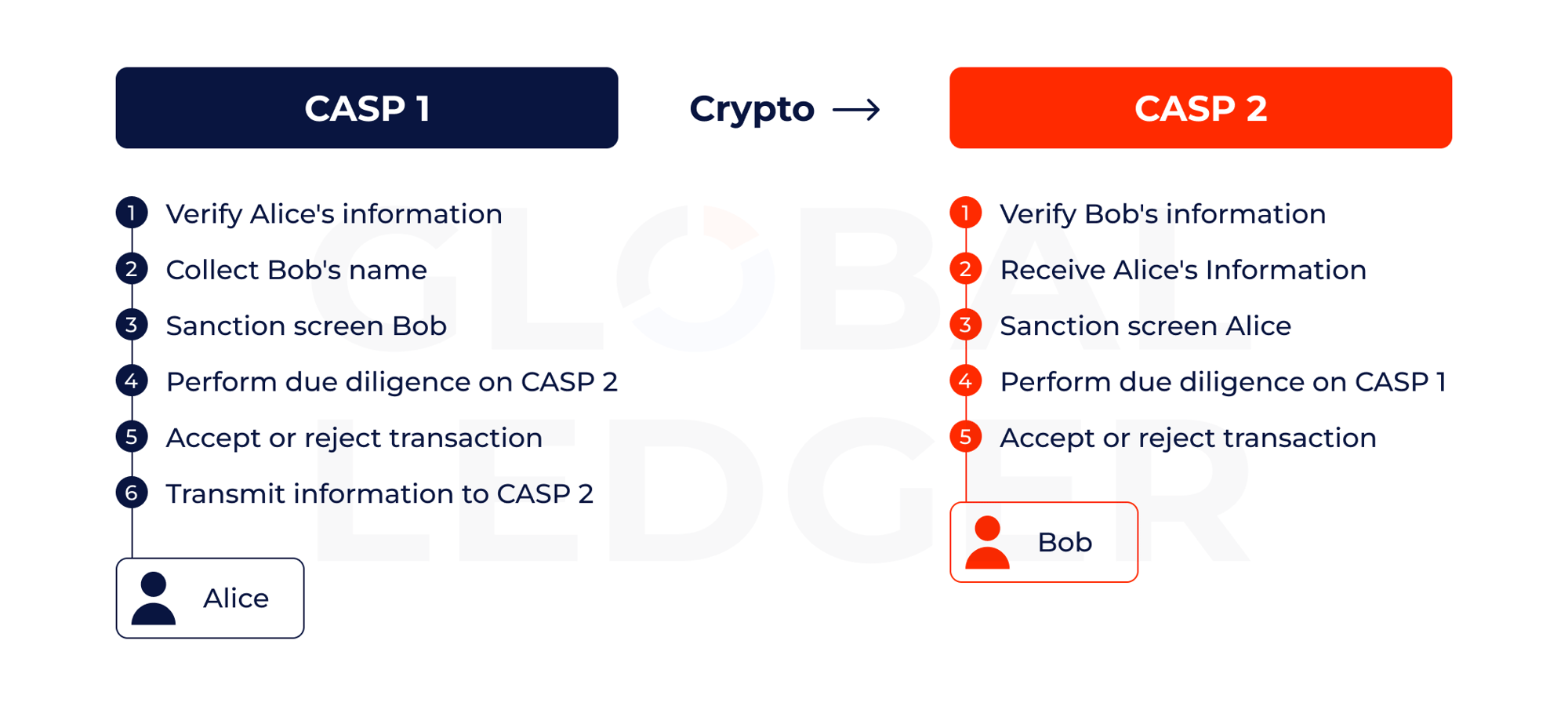
Travel Rule data flow between CASPs. Source: Global Ledger
What Is Travel Rule Compliance?
For VASPs, Travel Rule compliance in crypto refers to the full set of processes, systems, and controls used to meet Travel Rule obligations on an ongoing basis.
Knowing the rule is not compliance. A crypto firm is compliant when it can consistently:
-
collect and verify required data;
-
transmit it to counterparties;
-
detect missing or incomplete information and manage exceptions;
-
document every decision and retain records.
In practice, cryptocurrency Travel Rule compliance means building a workflow that works before, during, and after each transaction. As Travel Rule crypto regulation has tightened across a number of leading financial centres, the threshold for what counts as "compliant" has risen significantly — particularly around pre-transaction controls and self-hosted wallet handling.
The five obligations that define crypto Travel Rule compliance
-
Counterparty VASP identification.
Before transmitting data, a crypto firm must determine whether the receiving address belongs to a regulated VASP or a self-hosted wallet. The workflows and obligations differ significantly between the two cases.
-
Pre-transaction data collection and verification.
The originator VASP collects KYC-verified information on the sender and confirms beneficiary details before the transfer executes. Data must flow from verified records, not unverified user input.
-
Secure data transmission to the beneficiary VASP.
Data may be transmitted through a Travel Rule messaging solution or protocol, often using data standards such as IVMS 101, so the counterparty receives it before or at the moment of transfer.
-
Exception handling and escalation.
When Travel Rule information is missing, incomplete, inconsistent, or otherwise raises risk indicators, the VASP must detect this, apply a risk-based assessment, and escalate where appropriate under its internal procedures. This includes documenting the decision and, where relevant, integrating the information into broader AML/CFT controls such as sanctions screening, transaction monitoring, or suspicious activity reporting, which operate as separate obligations outside the Travel Rule itself.
Under EU TFR, the receiving CASP is specifically expected to have procedures for detecting whether required information is missing/incomplete and deciding whether to execute, reject, return, or suspend a transfer.
-
Record-keeping and audit trail.
Required Travel Rule information and related records should be retained for the period required under the applicable regime. In the EU, Regulation (EU) 2023/1113 requires retention for five years.
In 2026, regulators increasingly expect Travel Rule controls to operate before or at the time a transaction is executed — not solely after settlement. On-chain transfers are generally irreversible once broadcast, which means required originator and beneficiary information, as well as related risk indicators, should be identified and assessed as early as possible in the transaction lifecycle. In the EU and UK, firms that rely primarily on post-transaction remediation may struggle to meet supervisory expectations around effective Travel Rule compliance and risk management.
The Current State of Crypto Travel Rule Compliance
Despite years of regulatory alignment, Travel Rule compliance across the industry is still uneven. Many VASPs have implemented parts of the process, but few have achieved consistent, end-to-end coverage.
According to industry data, over 61% of VASPs report that most inbound transactions still arrive without the required Travel Rule data. In practice, this leaves compliance teams making decisions with incomplete information.
This gap is driven by four persistent challenges.
1. Self-hosted wallets remain the hardest edge case
Transfers involving self-hosted wallets introduce uncertainty that regulation has not fully resolved.
In the EU, firms are 55% more likely to block self-hosted wallet transactions than the global average, while over 15% of EU providers have banned self-custody transactions entirely due to regulatory uncertainty.
The challenge is both operational and interpretational. For example:
-
Under the EU Transfer of Funds Regulation (TFR), where a transfer involving a self-hosted address exceeds EUR 1,000, the CASP must assess and verify whether that address is owned or controlled by its customer. Practical implementation remains difficult, particularly where third-party wallets or complex custody arrangements are involved.
-
The EBA Guidelines on policies and procedures under Regulation (EU) 2023/1113 provide additional supervisory expectations on risk management, detection of missing information, and treatment of transfers involving self-hosted addresses.
-
Separately, DAC8 introduces additional crypto-asset tax reporting obligations in the EU, adding another layer of compliance complexity for firms handling transfers involving self-hosted wallets.
2. Fragmented protocols limit interoperability
There is still no single standard for Travel Rule data exchange. VASPs use different messaging systems that were built independently and do not always communicate with each other.
3. Pre-transaction controls are not yet universal
Many crypto firms have implemented Travel Rule workflows, but not all apply them at the most effective stage of the transaction lifecycle.
In practice, checks are still sometimes performed only after a transaction has been broadcast on-chain. However, regulators increasingly expect firms to collect, verify where required, and exchange relevant Travel Rule information before or at the time of transfer, rather than relying solely on post-transaction remediation. Given the irreversible nature of many blockchain transactions, firms are also expected to identify and escalate relevant risk indicators as early as possible.
4. The “sunrise” problem
A further challenge comes from uneven global implementation of the Travel Rule. When a VASP in a regulated jurisdiction interacts with a counterparty in a jurisdiction where the Travel Rule is not yet implemented or effectively operationalised, exchanging the required information may be difficult or inconsistent in practice.
In these situations, regulators generally expect firms to apply a risk-based approach. This may include:
-
Documenting attempts to transmit or obtain the required information.
-
Assessing relevant transactional and counterparty risk indicators, potentially including the use of blockchain analytics tools.
-
Applying internal escalation procedures and making a documented, risk-based decision on whether to proceed with the transfer.
Conclusion
In 2026, Travel Rule compliance is part of daily operations, not just a checkbox. Regulators expect VASPs not only to collect and transmit data correctly, but to manage exceptions, retain records, and ensure that Travel Rule data feeds into the broader AML controls that prevent illicit transactions from going undetected.
For compliance teams, the challenge is not understanding the rule — it is making it work across fragmented systems, unclear edge cases, and global counterparties. The firms that succeed are those that move from reactive compliance to structured, timely decision-making.
Global Ledger helps VASPs implement Travel Rule compliance end-to-end — from counterparty due diligence and pre-transaction screening to audit-ready reporting. Request a demo to find out how you can turn Travel Rule into a reliable, real-time workflow without blocking legitimate transactions or slowing down operations.